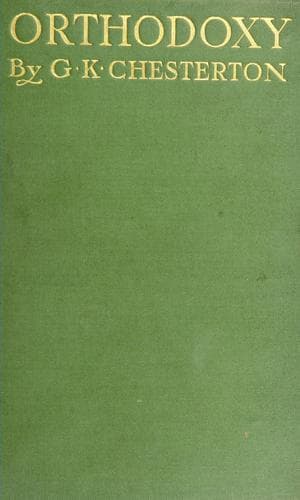
Apologetics; Chesterton, G. K. (Gilbert Keith), 1874-1936; Christianity -- Essence, genius, nature
But the important matter was this, that it entirely reversed the reason
for optimism. And the instant the reversal was made it felt like the
abrupt ease when a bone is put back in the socket. I had often called
myself an optimist, to avoid the too evident blasphemy of pessimism. But
all the optimism of the age had been false and disheartening for this
reason, that it had always been trying to prove that we fit in to the
world. The Christian optimism is based on the fact that we do _not_ fit
in to the world. I had tried to be happy by telling myself that man is
an animal, like any other which sought its meat from God. But now I
really was happy, for I had learnt that man is a monstrosity. I had
been right in feeling all things as odd, for I myself was at once worse
and better than all things. The optimist's pleasure was prosaic, for it
dwelt on the naturalness of everything; the Christian pleasure was
poetic, for it dwelt on the unnaturalness of everything in the light of
the supernatural. The modern philosopher had told me again and again
that I was in the right place, and I had still felt depressed even in
acquiescence. But I had heard that I was in the _wrong_ place, and my
soul sang for joy, like a bird in spring. The knowledge found out and
illuminated forgotten chambers in the dark house of infancy. I knew now
why grass had always seemed to me as queer as the green beard of a
giant, and why I could feel homesick at home.
CHAPTER VI.--_The Paradoxes of Christianity_
The real trouble with this world of ours is not that it is an
unreasonable world, nor even that it is a reasonable one. The commonest
kind of trouble is that it is nearly reasonable, but not quite. Life is
not an illogicality; yet it is a trap for logicians. It looks just a
little more mathematical and regular than it is; its exactitude is
obvious, but its inexactitude is hidden; its wildness lies in wait. I
give one coarse instance of what I mean. Suppose some mathematical
creature from the moon were to reckon up the human body; he would at
once see that the essential thing about it was that it was duplicate. A
man is two men, he on the right exactly resembling him on the left.
Having noted that there was an arm on the right and one on the left, a
leg on the right and one on the left, he might go further and still find
on each side the same number of fingers, the same number of toes, twin
eyes, twin ears, twin nostrils, and even twin lobes of the brain. At
last he would take it as a law; and then, where he found a heart on one
side, would deduce that there was another heart on the other. And just
then, where he most felt he was right, he would be wrong.
Public-domain text, read in full here on John Shaqi.
Reviews
Reviews
No reviews yet
Be the first to share your thoughts on this work.
Elsewhere in the archive
Join the Discussion
Join the discussion
Sign in to leave a comment or review.
Sign InorCreate an account