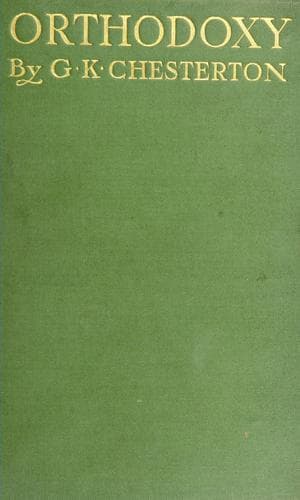
Apologetics; Chesterton, G. K. (Gilbert Keith), 1874-1936; Christianity -- Essence, genius, nature
I have alluded to an unmeaning phrase to the effect that such and such a
creed cannot be believed in our age. Of course, anything can be
believed in any age. But, oddly enough, there really is a sense in which
a creed, if it is believed at all, can be believed more fixedly in a
complex society than in a simple one. If a man finds Christianity true
in Birmingham, he has actually clearer reasons for faith than if he had
found it true in Mercia. For the more complicated seems the coincidence,
the less it can be a coincidence. If snowflakes fell in the shape, say,
of the heart of Midlothian, it might be an accident. But if snowflakes
fell in the exact shape of the maze at Hampton Court, I think one might
call it a miracle. It is exactly as of such a miracle that I have since
come to feel of the philosophy of Christianity. The complication of our
modern world proves the truth of the creed more perfectly than any of
the plain problems of the ages of faith. It was in Notting Hill and
Battersea that I began to see that Christianity was true. This is why
the faith has that elaboration of doctrines and details which so much
distresses those who admire Christianity without believing in it. When
once one believes in a creed, one is proud of its complexity, as
scientists are proud of the complexity of science. It shows how rich it
is in discoveries. If it is right at all, it is a compliment to say
that it's elaborately right. A stick might fit a hole or a stone a
hollow by accident. But a key and a lock are both complex. And if a key
fits a lock, you know it is the right key.
But this involved accuracy of the thing makes it very difficult to do
what I now have to do, to describe this accumulation of truth. It is
very hard for a man to defend anything of which he is entirely
convinced. It is comparatively easy when he is only partially convinced.
He is partially convinced because he has found this or that proof of the
thing, and he can expound it. But a man is not really convinced of a
philosophic theory when he finds that something proves it. He is only
really convinced when he finds that everything proves it. And the more
converging reasons he finds pointing to this conviction, the more
bewildered he is if asked suddenly to sum them up. Thus, if one asked an
ordinary intelligent man, on the spur of the moment, "Why do you prefer
civilisation to savagery?" he would look wildly round at object after
object, and would only be able to answer vaguely, "Why, there is that
bookcase ... and the coals in the coal-scuttle ... and pianos ... and
policemen." The whole case for civilisation is that the case for it is
complex. It has done so many things. But that very multiplicity of proof
which ought to make reply overwhelming makes reply impossible.
Public-domain text, read in full here on John Shaqi.
Reviews
Reviews
No reviews yet
Be the first to share your thoughts on this work.
Elsewhere in the archive
Join the Discussion
Join the discussion
Sign in to leave a comment or review.
Sign InorCreate an account