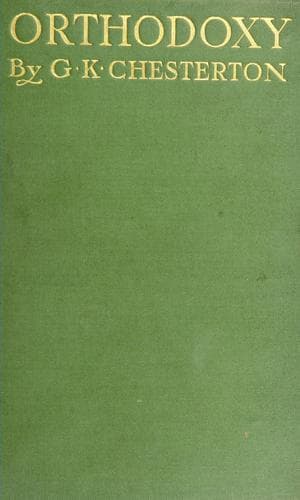
Apologetics; Chesterton, G. K. (Gilbert Keith), 1874-1936; Christianity -- Essence, genius, nature
Some fall back simply on the clock: they talk as if mere passage through
time brought some superiority; so that even a man of the first mental
calibre carelessly uses the phrase that human morality is never up to
date. How can anything be up to date? a date has no character. How can
one say that Christmas celebrations are not suitable to the twenty-fifth
of a month? What the writer meant, of course, was that the majority is
behind his favourite minority--or in front of it. Other vague modern
people take refuge in material metaphors; in fact, this is the chief
mark of vague modern people. Not daring to define their doctrine of what
is good, they use physical figures of speech without stint or shame,
and, what is worst of all, seem to think these cheap analogies are
exquisitely spiritual and superior to the old morality. Thus they think
it intellectual to talk about things being "high." It is at least the
reverse of intellectual; it is a mere phrase from a steeple or a
weathercock. "Tommy was a good boy" is a pure philosophical statement,
worthy of Plato or Aquinas. "Tommy lived the higher life" is a gross
metaphor from a ten-foot rule.
This, incidentally, is almost the whole weakness of Nietzsche, whom some
are representing as a bold and strong thinker. No one will deny that he
was a poetical and suggestive thinker; but he was quite the reverse of
strong. He was not at all bold. He never put his own meaning before
himself in bald abstract words: as did Aristotle and Calvin, and even
Karl Marx, the hard, fearless men of thought. Nietzsche always escaped a
question by a physical metaphor, like a cheery minor poet. He said,
"beyond good and evil," because he had not the courage to say, "more
good than good and evil," or, "more evil than good and evil." Had he
faced his thought without metaphors, he would have seen that it was
nonsense. So, when he describes his hero, he does not dare to say, "the
purer man," or "the happier man," or "the sadder man," for all these are
ideas; and ideas are alarming. He says "the upper man," or "over man," a
physical metaphor from acrobats or alpine climbers. Nietzsche is truly
a very timid thinker. He does not really know in the least what sort of
man he wants evolution to produce. And if he does not know, certainly
the ordinary evolutionists, who talk about things being "higher," do not
know either.
Then again, some people fall back on sheer submission and sitting still.
Nature is going to do something some day; nobody knows what, and nobody
knows when. We have no reason for acting, and no reason for not acting.
If anything happens it is right: if anything is prevented it was wrong.
Again, some people try to anticipate nature by doing something, by doing
anything. Because we may possibly grow wings they cut off their legs.
Yet nature may be trying to make them centipedes for all they know.
Public-domain text, read in full here on John Shaqi.
Reviews
Reviews
No reviews yet
Be the first to share your thoughts on this work.
Elsewhere in the archive
Join the Discussion
Join the discussion
Sign in to leave a comment or review.
Sign InorCreate an account