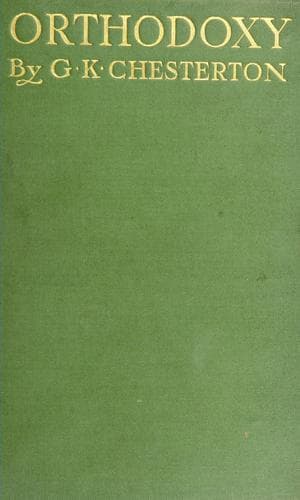
Apologetics; Chesterton, G. K. (Gilbert Keith), 1874-1936; Christianity -- Essence, genius, nature
If you want to treat a tiger reasonably, you must go back to the garden
of Eden. For the obstinate reminder continued to recur: only the
supernatural has taken a sane view of Nature. The essence of all
pantheism, evolutionism, and modern cosmic religion is really in this
proposition: that Nature is our mother. Unfortunately, if you regard
Nature as a mother, you discover that she is a step-mother. The main
point of Christianity was this: that Nature is not our mother: Nature is
our sister. We can be proud of her beauty, since we have the same
father; but she has no authority over us; we have to admire, but not to
imitate. This gives to the typically Christian pleasure in this earth a
strange touch of lightness that is almost frivolity. Nature was a solemn
mother to the worshippers of Isis and Cybele. Nature was a solemn mother
to Wordsworth or to Emerson. But Nature is not solemn to Francis of
Assisi or to George Herbert. To St. Francis, Nature is a sister, and
even a younger sister: a little, dancing sister, to be laughed at as
well as loved.
This, however, is hardly our main point at present; I have admitted it
only in order to show how constantly, and as it were accidentally, the
key would fit the smallest doors. Our main point is here, that if there
be a mere trend of impersonal improvement in Nature, it must presumably
be a simple trend towards some simple triumph. One can imagine that some
automatic tendency in biology might work for giving us longer and longer
noses. But the question is, do we want to have longer and longer noses?
I fancy not; I believe that we most of us want to say to our noses,
"Thus far, and no farther; and here shall thy proud point be stayed": we
require a nose of such length as may ensure an interesting face. But we
cannot imagine a mere biological trend towards producing interesting
faces; because an interesting face is one particular arrangement of
eyes, nose, and mouth, in a most complex relation to each other.
Proportion cannot be a drift: it is either an accident or a design. So
with the ideal of human morality and its relation to the humanitarians
and the anti-humanitarians. It is conceivable that we are going more and
more to keep our hands off things: not to drive horses; not to pick
flowers. We may eventually be bound not to disturb a man's mind even by
argument; not to disturb the sleep of birds even by coughing. The
ultimate apotheosis would appear to be that of a man sitting quite
still, not daring to stir for fear of disturbing a fly, nor to eat for
fear of incommoding a microbe. To so crude a consummation as that we
might perhaps unconsciously drift. But do we want so crude a
consummation? Similarly, we might unconsciously evolve along the
opposite or Nietzscheian line of development--superman crushing superman
in one tower of tyrants until the universe is smashed up for fun. But do
we want the universe smashed up for fun? Is it not quite clear that what
Public-domain text, read in full here on John Shaqi.
Reviews
Reviews
No reviews yet
Be the first to share your thoughts on this work.
Elsewhere in the archive
Join the Discussion
Join the discussion
Sign in to leave a comment or review.
Sign InorCreate an account