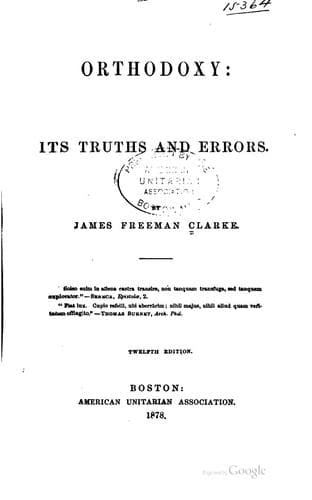
Orthodoxy: Its Truths And ErrorsClarke, James Freeman
Religion
Orthodoxy: Its Truths And Errors
Clarke, James Freeman
Unitarianism
It is true that I find evil tendencies in me, which I did not cause; but I
know, that, for whatever part I am not the cause, I am not accountable.
For this part of my life I do not dread the wrath, but rather claim the
pity, of my God. My nature I find to be diseased—not well; needing cure,
and not merely food and exercise. I can, therefore, the more easily
believe that God has sent me a physician, and that I shall be cured by
him. I can believe in a future emancipation from these tendencies to
vanity, sensuality, indolence, anger, wilfulness, impatience,
obstinacy—tendencies which are, in me, not crime, but disease; and I can
see how to say with Paul, “Now, then, it is no more _I_ that do it, but
SIN THAT DWELLETH IN ME.”
If, now, we return to the consideration of the Orthodox doctrine of the
fall, as set forth by the Westminster Assembly, we shall find it to be
half true and half false. It states _truly_ (chap. 6, § 1) that our first
parents sinned, and also (§ 2) that by this sin they fell from their
original righteousness; for this only means that the first conscious act
of disobedience by man produced alienation from God, and degeneracy of
nature. This was no arbitrary punishment, but the natural consequence. The
creed also says _truly_ (§ 3) that this corrupted nature was conveyed to
all their posterity; for this only means, that, by the laws of descent,
good and evil qualities are transmitted; which all wise observers of human
nature knew to be the fact. It is also _true_ (§ 5) that this corrupt
nature does remain (to some extent at least), even in the regenerate, in
this life.
So far, so true. Sin, as disease, began with the first man, in his first
sin, and has been transmitted, by physical, moral, and spiritual
influences, from him to us all.
But now we find complicated with these truths other statements, which we
must need regard as falsehoods. Tried either by reason or Scripture, they
are palpably untrue, and are very dangerous errors.
The first error of Orthodoxy is in declaring transmitted or inherited evil
to be total. It declares that our first parents “were _wholly_ defiled in
all faculties and parts of soul and body,” and that _we_, in consequence,
“are utterly indisposed, disabled, and made opposite to all good, and
wholly inclined to all evil.” This statement is indefensible. But we shall
consider this in another section on “Total Depravity,” and only allude to
it now in passing.
Another error, however, and a very important one, is to attribute the
_guilt_ of Adam and Eve to their descendants. This is the famous doctrine
of _imputation_, which is now rejected by all the leading schools of
modern Orthodoxy. That we can be _guilty_ of Adam’s sin, either by
imputation or in any other way, seems too absurd and immoral a statement
to be now received.
Public-domain text, read in full here on John Shaqi.
Reviews
Reviews
No reviews yet
Be the first to share your thoughts on this work.
Elsewhere in the archive
Join the Discussion
Join the discussion
Sign in to leave a comment or review.
Sign InorCreate an account