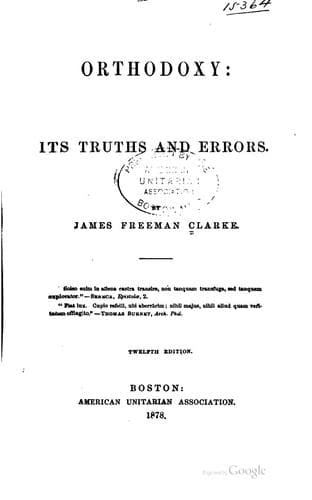
Orthodoxy: Its Truths And ErrorsClarke, James Freeman
Religion
Orthodoxy: Its Truths And Errors
Clarke, James Freeman
Unitarianism
One bad consequence of the Orthodox idea is discouragement on the one
side, and spiritual pride on the other. Those who are not converted are
discouraged, and deprived of the comforts of Christian faith. Those who
think they have been converted are satisfied with this past experience,
and believe themselves Christians on the strength of it. Because some
spiritual commotion took place in their souls at a certain time and place,
they consider themselves children of God and heirs of his favor, though in
their daily lives they may show little proof of practical Christianity.
And the result of this, again, is a professed distrust, by the majority of
sensible men, of such conversions. Men of the world do not find that
professed Christians are better than themselves. Often, indeed, church
members are not so just, honest, manly, or truthful as those who make no
claim to religion. And the reason is simply this—that they have been
taught to believe that the essence of Christianity does not consist in
righteousness, but in certain religious experiences.
§ 10. The Essential Thing for Man is to repent and be converted; that is,
to make it his Purpose to obey God in all Things.
As far as man is concerned, repentance is the one thing needful. But by
repentance we do not mean sorrow or contrition, but simply turning round
whenever we are going wrong, and beginning at once to go right. This is
something in every man’s power, and this makes him a Christian; this gives
him a claim to all the promises and hopes of the gospel here and
hereafter. It would seem that there need be no doubt as to the nature of
repentance while the parable of the prodigal son stands in the Bible. That
divine story gives us the whole theory of repentance and
regeneration—repentance being that which comes from man, regeneration that
which is given by God. When the prodigal son was aware of his sin and
sorrow, and said, “I will arise, and go to my father;” and when he arose,
and went to his father, and confessed his sin and need, then he had
repented. It was simply going to his father with the purpose of obedience.
And when the father received him, not with reproach, but with pardon and
joy, then he was born again, introduced into a new life, into the peace,
and love, and freedom of his own home.
Public-domain text, read in full here on John Shaqi.
Reviews
Reviews
No reviews yet
Be the first to share your thoughts on this work.
Elsewhere in the archive
Join the Discussion
Join the discussion
Sign in to leave a comment or review.
Sign InorCreate an account