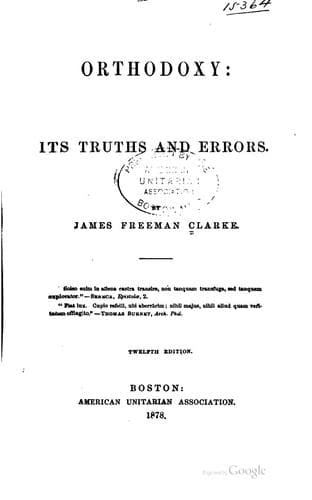
Orthodoxy: Its Truths And ErrorsClarke, James Freeman
Religion
Orthodoxy: Its Truths And Errors
Clarke, James Freeman
Unitarianism
Now, if his state of mind, thus described, had been at that time exposed
and told, it would not have been thought a very sound Orthodox experience.
But in reality the boy was at that very time as good a Christian for a boy
as he is now for a man. But Miss Beecher, in the book referred to, tells
us that when one of her other brothers was striving in prayer for this
change of heart, with groans and struggles, the house was like a tomb. The
poor young man was in his chamber alone, and his groans and cries were
heard through the whole house. All the other members of the family staid
in their own rooms in silence, until at last, by some natural reaction of
feeling, there came a sense of rest and peace to his mind, which they
believed to be the new birth. She also describes the way in which Dr.
Payson, of Portland, tortured his little daughter, three years old, by a
torture as well meant, as conscientious, and more terrible than that of
the Holy Inquisition. He told his little daughter that she hated God; that
she must have a change of heart, but that she could not get it for
herself; and that even her prayers, until she was converted, were only
making her worse. The poor little girl denied that she hated God; she said
she was sure she loved him. Then the misguided father brought up all her
little childish faults as a proof that she hated God; for if she loved him
she would never do wrong. And so, from three years of age till she was
thirteen, this poor, infatuated parent tormented this little child by
keeping her on this spiritual rack—all because of a false view of the
passages concerning regeneration in the Bible. And when we think of the
twenty thousand pulpits which to-day are teaching in this country this
same sort of belief, it is evident that it is our duty to see what the
Master really meant to teach us by this passage.
Nicodemus is the type of a class of men common in all times. We have seen
Nicodemus very often. He is a good man whose goodness has no life in it.
His goodness is a sort of an automaton—all machinery and no soul. He is so
thoroughly right in all he does; everything about him is so proper; he is
so perfectly _en règle_ in his own eyes,—that we sometimes wish that he
might be betrayed into some impropriety, commit some not too great folly,
have some _escapade_ of rash enthusiasm. You respect him so much, you
wonder why you do not love him more. It is because he is not open to
influence. His goodness is so rigid, his opinions so declared, his
character so pronounced, that there is no crack anywhere by which God or
man can reach him. He has a whole armor of opinions all round him, and you
cannot get through it. He has narrowed himself, and shut himself in, so
that he feels no influence of sympathy coming from the wide ocean of
humanity around, no influence of love from the deep heaven of God above.
He is a sort of good rhinoceros, with a skin so thick that nothing can
pierce it.
Public-domain text, read in full here on John Shaqi.
Reviews
Reviews
No reviews yet
Be the first to share your thoughts on this work.
Elsewhere in the archive
Join the Discussion
Join the discussion
Sign in to leave a comment or review.
Sign InorCreate an account