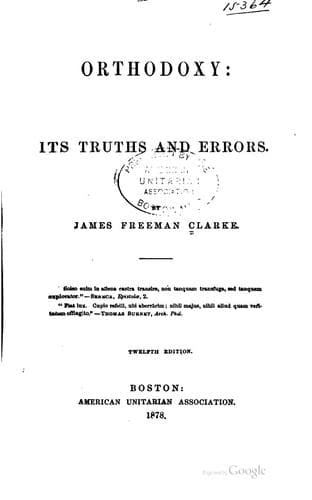
Orthodoxy: Its Truths And ErrorsClarke, James Freeman
Religion
Orthodoxy: Its Truths And Errors
Clarke, James Freeman
Unitarianism
And again: is it not thought by Orthodox people, that, in order to be
justified and have peace with God through Jesus Christ, it is necessary
that a person should experience certain feelings, beginning with a sense
of guilt, a fear of punishment, and passing into a state of hope and
assurance? And, accordingly, men make it a WORK, and labor, to have these
feelings in the precise order and manner, and, until they can experience
these feelings, believe that they can have no access to God. As before, we
do not mean that these feelings are unimportant, but only that we should
not try to work ourselves up into certain feelings in order to be just
before God. It is faith in Jesus which is the _source_, not the _result_,
of piety as well as of holiness. It is faith in God’s love to us which
enables us to love him. The sense of pardon produces both the feeling of
gratitude and of unworthiness. God does not forgive us because we have had
the right feelings, but that we may have them. Those love much to whom
much is forgiven; but to whom little is forgiven, the same love little.
Were we ever struck with the remarkable contrast between the conversions
to God in the apostolic time and those which we hear of now? How much more
_simple_ they were! A man is riding in a chariot, reading his Bible, and
trying in vain to comprehend it. An apostle comes, and explains to him the
prophecy, and applies it to Jesus. Presently they come to water, and he
says, “See, here is water;” he is baptized, and goes on his way rejoicing.
We fear there are not many churches now who would receive that Ethiopian
as a member, if he could give no further account of his religious
experience than is recorded in the book of Acts.
But is it not, we say again, remarkable, that not only in this case, but
in all the cases of conversion recorded and described in the Acts, there
should be nothing of the descriptions which we read every week in our
religious newspapers? In the case of the three thousand baptized on the
day of Pentecost, we only read that they were cut to the heart; said,
“What shall we do?” were told to repent and be baptized; joyfully received
the word, and were baptized. Even the remarkable conversion of Paul was
nothing like what we now have. How is this—that now we are not willing to
trust to a simple act of faith in Jesus Christ, and in turning to God; but
we have a scale and rule of religious experience—a work which all must go
through in order to be justified?
Public-domain text, read in full here on John Shaqi.
Reviews
Reviews
No reviews yet
Be the first to share your thoughts on this work.
Elsewhere in the archive
Join the Discussion
Join the discussion
Sign in to leave a comment or review.
Sign InorCreate an account