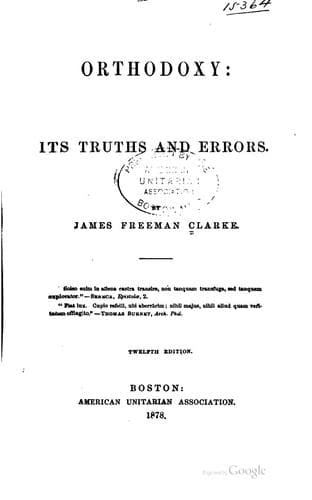
Orthodoxy: Its Truths And ErrorsClarke, James Freeman
Religion
Orthodoxy: Its Truths And Errors
Clarke, James Freeman
Unitarianism
Liberal Christians have fallen into error of a different sort. They seek
to be justified, not by opinion nor by feeling, but by action; by works of
righteousness, honesty, charity; by the faithful performance of social
duties; by an active obedience to the law of God. Looking at the
Scriptures, and seeing in how many places we are plainly taught that we
are to work out our own salvation; to be rewarded and punished according
to our active goodness; to be judged by our works,—they say that a man is
forgiven when he has corrected his fault, and not before; that repentance
and reformation are the only means of atonement with God; that, if we wish
to be forgiven, we must reform our conduct and change our character.
Accordingly, they lay great stress on DUTY, and are continually exhorting
men to the performance of their duties in order to be forgiven.
But there is a mistake here also, which arises from confounding two very
different things; namely, justification and final salvation. We have seen
that the consequences of sin are twofold—external and internal. The inward
consequence of sin is separation from God; the external is the weakening
and debasing of the soul. The first consequence is removed by faith; the
second, by obedience. Every act of sin pollutes, darkens, and ruins the
soul; every act of obedience strengthens, elevates, and saves it.
Obedience, persevered in to the end, insures the salvation of the soul.
But, in order that we may obey, we must first be justified; for what is to
give us the strength and the heart to obey, except the pardoning love of
God? It is this sense of reconciliation,—it is this spirit of adoption,
whereby we cry, “Abba, Father,”—which gives us the power to obey. We do
not obey God to be forgiven; but we are forgiven that we may obey. Have we
read the Gospels, and have we forgotten all the instances in which Jesus
said, “Thy sins are forgiven thee,” before there had been any change of
conduct, or reform of character? and have we forgotten the memorable
passage in which he explains to the captious Pharisee why he does this
(Luke 7:36-50),—on the principle that the one to whom the most is forgiven
will love the most?
Public-domain text, read in full here on John Shaqi.
Reviews
Reviews
No reviews yet
Be the first to share your thoughts on this work.
Elsewhere in the archive
Join the Discussion
Join the discussion
Sign in to leave a comment or review.
Sign InorCreate an account