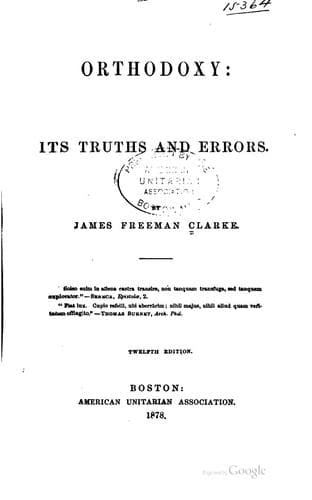
Orthodoxy: Its Truths And ErrorsClarke, James Freeman
Religion
Orthodoxy: Its Truths And Errors
Clarke, James Freeman
Unitarianism
Then came the controversy between Augustine and Pelagius. The latter,
being at Rome, heard this sentence read from the writings of the former:
“_Da quod jubes, et jube quod vis_”—Give what thou commandest, and command
what thou willest. Pelagius objected to this formula. He said, “Since man
ought to be without sin, he can be without sin.” “There is,” said he, “in
man, a ‘_Can Do_,’ a ‘_Will Do_,’ and a ‘_Do_.’ ” The first is from God;
in the others God and man unite.
Augustine objected that God worked in us both to will and to do. He had
first taught that God sends motives which we can obey or resist; but he
saw that if God works in us to will, he must also conquer our resistance,
and work the power by which we consent.
But to this Pelagius replied, “Then there is no freedom in man.”
Augustine answered, “God does not move us as we move a stone, but
rationally; he makes us _will_ what is good, and does not force us against
our will. He frees the will from its proclivity to evil, by ‘preparing
grace,’ and determines it to good by ‘effecting grace.’ That some do not
yield to this, is not because of their greater resistance, but because God
does not choose to conquer their resistance.”
This is the point where grace passes into predestination.
The Old Church had maintained that God predestined to life those whom he
_foresaw_ would repent and obey him. His foreknowledge did not cause this
to happen, but he foreknew it because it would happen. It did not take
place because he foresaw it, but he foresaw it because it would take
place.
Election, according to the early Fathers, was nothing arbitrary. It
depended on man to be saved or lost. So taught Justin Martyr, Origen,
Basil, Hilary.
Basil said, “God hardened Pharaoh’s heart by his judgments, which were
sent to show how hard it was, because he saw he would not repent.”
Origen adds, “Like a wise physician, God did not cure Pharaoh too soon,
for fear of a relapse. He let him drink the cup of sin to the bottom in
this life, so as to cure him more thoroughly hereafter.”
Pelagius (and Augustine at first) took the same view. They said that God
foresees and permits evil, and decrees the consequence of it.
Augustine said, “God has chosen some men in Christ, not because he foresaw
they would be good, but because he determined to make them so.” The reason
of this choice, therefore, lay not in man, but in God’s arbitrary will.
Pelagius said, “This is fatalism, under the name of grace, and is saying
that God accepts the persons of men.”
Augustine answered, “All men in Adam are in ruin. God saves some of them.
If he let _all_ die, we could not blame him: how much less for saving
some!”
But why does he _not_ save all? The answer is,—
Because the elect see in the fate of the non-elect what they have escaped,
and God’s justice is revealed with his goodness.
None of the elect perish, though they may die unbaptized, and be ever so
bad in their lives; but they will be all converted before they die.
Public-domain text, read in full here on John Shaqi.
Reviews
Reviews
No reviews yet
Be the first to share your thoughts on this work.
Elsewhere in the archive
Join the Discussion
Join the discussion
Sign in to leave a comment or review.
Sign InorCreate an account