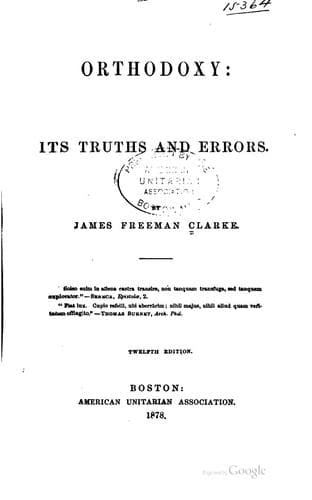
Orthodoxy: Its Truths And ErrorsClarke, James Freeman
Religion
Orthodoxy: Its Truths And Errors
Clarke, James Freeman
Unitarianism
God selected Jacob and rejected Esau. “Jacob have I loved, and Esau have I
hated.” But how did God love Jacob? He loved him by giving him
opportunity. And why? Not because he was better than Esau, but because he
was different. Jacob was selected to be father of the chosen people
because he had the qualities required for his work. Esau was wild,
reckless, martial. Jacob was industrious, money-making, fond of small
trade; pastoral, rather than warlike; tenacious of his ideas even to
obstinacy. These were the qualities required in a people who were so few
that if they had been warlike they would have been swept from the earth.
They never fought for the pleasure of fighting, but only when they could
not help it, or when a political necessity compelled it. Though surrounded
by nations much more powerful than themselves,—the Assyrians on the
north-east at Nineveh, the Egyptians on the south-west, the Babylonians on
the east, the Tyrians on the west, and the Greeks on the north-west,—they
saw the fall of all these great nations and empires, but they continued.
Many waves of war swept over their Syrian hills, and left them still
there, peaceful, industrious, worshipping Jehovah in their sacred city,
offering no motive for conquest, too poor to tempt invasion, too far from
the sea to grow rich by commerce, like the Phœnicians. Their obscurity,
poverty, and unheroic qualities were their salvation, and these they
derived apparently from Jacob, their ancestor.
Thus we see that the Jews were a chosen people, and we see what they were
chosen for, and also that they were chosen not because of superior virtue,
but for superior capacity.
§ 6. How other Nations were elected and called.
Other nations were chosen, too, for other purposes. The Greeks also were a
chosen people—chosen to develop the idea of beauty, as the Jews that of
religion. Their mission was beauty in art and in literature. It was no
accident that they came as they did from confluent races, flowing together
from India and Phœnicia, and settling in that sweet climate and romantic
land, where the lovely Ægean, tossing its soft blue waters on the
resounding shore, tempted them to navigation, and awakened their intellect
by the sight of many lands. There they did their work. They made their
calling and election sure. Greek architecture—one birth of beauty after
another—was born. Athens was crowned with marvellous temples, whose
exquisite proportions amaze and charm us to-day—inimitable creations of
beauty. Homer came, and then epic poetry was born. Æschylus and tragedy
came; Pindar and the lyric song; Theophrastus and pastoral music; Anacreon
and the strain which bears his special name. And so Phidias and his
companions created sculpture, Herodotus history, Demosthenes oratory,
Plato and Aristotle philosophy, Zeuxis painting, and Pericles
statesmanship. This was their election, and they made it sure.
Public-domain text, read in full here on John Shaqi.
Reviews
Reviews
No reviews yet
Be the first to share your thoughts on this work.
Elsewhere in the archive
Join the Discussion
Join the discussion
Sign in to leave a comment or review.
Sign InorCreate an account