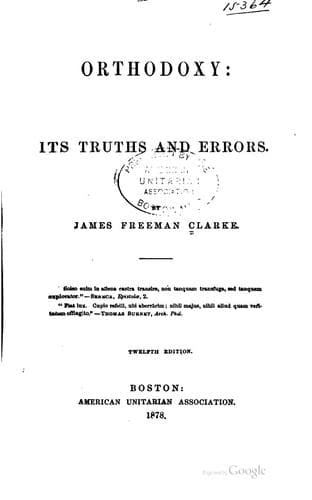
Orthodoxy: Its Truths And ErrorsClarke, James Freeman
Religion
Orthodoxy: Its Truths And Errors
Clarke, James Freeman
Unitarianism
The other point is the passage in 1 Cor. 11:31: “If we would judge
ourselves, we should not be judged.” Here a principle seems to be laid
down—that just so far as we apply God’s truth to our own hearts and
consciences, we do not need to have it applied by God. And this
corresponds with the account of the judgment to which we have before
referred, in the twenty-fifth chapter of Matthew. Those who are there
called up for judgment, and who stand before the throne, are not Jews or
Christians, but Gentiles (τὰ ἔθνη). The holy angels are with Christ in his
glory. The heathen appear before him; those who have been doing good
without knowing it are received by him into his kingdom, as those who have
been blessed by his Father. They are Christians, it appears, without
knowing it. They inherit the kingdom, from which the original heirs who
have been wicked and slothful servants, and who have buried their talent
in the napkin, are excluded. Christians who have judged themselves, and
applied Christianity by their own lives, are not to be judged at the
coming of Christ, but only those who have been doing right or wrong
ignorantly.(45)
§ 11. Final Result.
The course of our investigations in the present chapter has brought us to
this result. Orthodoxy is right in expecting the coming of Christ in this
world, but wrong in supposing it wholly future and wholly outward. It is
right in making it a _personal_ coming, and not merely the coming of his
truth apart from him, but wrong in conceiving of this personal coming, as
material to the senses, instead of spiritual to the soul. It is right in
expecting a judgment, but wrong in placing it only in the other world. It
is right in supposing that all mankind, the converted, the unconverted,
and the heathen, are to be judged by Christian truth, but wrong in
supposing that this judgment must occur in one place or at one time.
Finally, in this, as in regard to many other doctrines, Orthodoxy fails by
neglecting the great saying of Jesus, “THE SPIRIT QUICKENETH, THE FLESH
PROFITETH NOTHING,” and the similar statement of Paul, “THE LETTER
KILLETH.”
CHAPTER XIV. ETERNAL PUNISHMENT, ANNIHILATION, UNIVERSAL RESTORATION.
§ 1. Different Views concerning the Condition of the Impenitent hereafter.
The different views concerning the future state, held by the Christian
Church, may be thus classified; arranging them, exhaustively, under eight
divisions:—
I. The Roman Catholic Church makes three conditions hereafter; viz.,—
1. Everlasting joy.
2. Everlasting suffering.
3. Temporal sorrow in purgatory.
II. The Orthodox Protestant Church makes two conditions hereafter; viz.,—
1. Unmixed and everlasting joy.
2. Unmixed and everlasting suffering.
III. The Old School Universalists make one condition hereafter; viz.,—
1. Eternal joy.
IV. New School Universalists and Restorationists make two conditions
hereafter; viz.,—
1. Eternal joy.
2. Temporal and finite suffering.
Public-domain text, read in full here on John Shaqi.
Reviews
Reviews
No reviews yet
Be the first to share your thoughts on this work.
Elsewhere in the archive
Join the Discussion
Join the discussion
Sign in to leave a comment or review.
Sign InorCreate an account