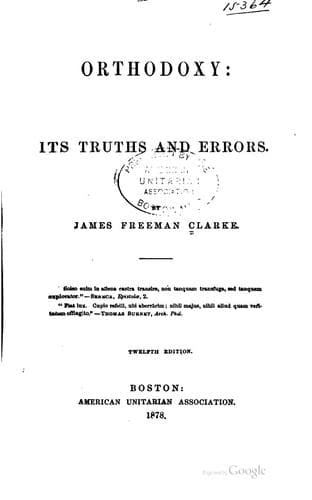
Orthodoxy: Its Truths And ErrorsClarke, James Freeman
Religion
Orthodoxy: Its Truths And Errors
Clarke, James Freeman
Unitarianism
It means that the suffering to be endured hereafter by each individual
soul, as a punishment for sins committed in this world, will infinitely
exceed in amount all the suffering borne on the surface of the earth, by
its total population, from the creation of Adam to the destruction of the
world. Each lost soul will suffer not only more, but infinitely more, than
all the accumulated sufferings of the human race throughout all time. We
shudder as we read the account of the sufferings from hydrophobia, or the
burning alive of a slave at the South, or the tortures inflicted by the
Holy Inquisition, or the horrors of a field of battle, or the cruelties
inflicted by savages upon their victims; but all of these, added together,
are finite, and the sufferings of a single soul hereafter are infinite.
That is to say, all the pain and evil of this world, resulting from all
human sin, through all time, is infinitely small and insignificant when
compared with the punishment endured by a single soul hereafter for his
share of that sin. And all this is inflicted by God; and he is a God of
love.
There are some doctrines, the statement of which is their refutation.
This, we think, is one of them.
But it must also be considered, that this doctrine, which throws such
darkness over the future, also sends down a rayless night over the
present. It refutes every theodicy; it nullifies every solution of evil.
The consolation for the sufferings of this world is, that the fashion of
this world passes away, and that there is a better world to come. The
explanation of the evils of this life is, that they are finite, and that
they are, therefore, to be swallowed up and to disappear in an infinite
good. The Christian finds relief, in considering the sufferings of this
world, by regarding them as the means of a greater ultimate joy; by
looking forward to the time when all tears shall be wiped away; and by a
firm faith that love is stronger than selfishness, good stronger than
evil. But the doctrine of eternal punishment gives us, in the condition of
a single lost soul, a greater amount of evil hereafter than all the evil,
which is to be thus explained, here; and the myriads of lost souls, each
of which is to suffer infinitely more than all the sufferings of the
present world, present us with a problem, in the future, so appalling,
that the problem of present evil, vast as it is, becomes insignificant by
its side.
We are tormented with evil here. We seek a solution of the problem: we
find it in the limited, finite, and ancillary nature of evil. But that
solution is wholly taken away when we are told that evil is infinite and
eternal.
Public-domain text, read in full here on John Shaqi.
Reviews
Reviews
No reviews yet
Be the first to share your thoughts on this work.
Elsewhere in the archive
Join the Discussion
Join the discussion
Sign in to leave a comment or review.
Sign InorCreate an account