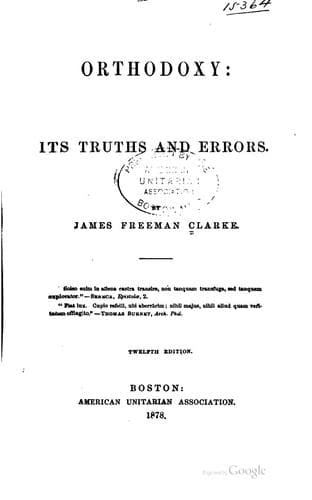
Orthodoxy: Its Truths And ErrorsClarke, James Freeman
Religion
Orthodoxy: Its Truths And Errors
Clarke, James Freeman
Unitarianism
This is the doctrine which every denomination and sect in Christendom,
except the Unitarians and Universalists, maintain as essential to
Orthodoxy. It is but a year or two since twenty-one bishops of the
Protestant Episcopal Church issued a declaration of their belief that this
doctrine is maintained, without reserve or qualification, by the Church of
England. Only recently an ecclesiastical council of Congregationalists
refused the fellowship of the churches to a gentleman elected as its
pastor by the Third Congregational Church in Portland, Maine. In the
report of the result, the council says that it believes the candidate to
be generally sound in his belief, and exemplary in his Christian spirit,
and heartily extends to him its Christian sympathy. But it declines to
install him as pastor, because it “understands him as saying, that he does
not know but there may be another state of probation and offer of
salvation, after death, for all to whom Christ is not personally preached;
and that, whilst believing in a future retribution, he says that the
everlasting punishment of the wicked may be an extinction of the wicked by
annihilation.” So that a mere doubt on this subject is considered a
sufficient reason, by the most advanced and liberal of the whole Orthodox
body at the present day, for refusing church fellowship.
The American Tract Society floods the land with loose leaves, all
appealing to the fear of an eternal hell. We have one before us now,
called “Are you insured?” which represents Christianity as a contrivance
for escaping from everlasting torment, as a spiritual insurance office,
where one must “take out a policy,” and so escape everlasting fire.(47)
There is no theological journal, bearing the Orthodox name, which is more
rational and liberal than the “New York Independent.” But in its issue of
January 5, 1860, it speaks of future endless misery thus, saying that
there is a “vast amount and weight of evidence to the point—evidence
enough to prove it, if provable; all nature, all law, all revelation
uttering the doctrine, so that it is an amazing stretch and energy of
unbelief not to believe it, implying a moral state and position that will
not believe it on any testimony, however clearly and unqualifiedly, even
to the exhaustion of the capabilities of language, God himself may declare
and affirm it.”
Public-domain text, read in full here on John Shaqi.
Reviews
Reviews
No reviews yet
Be the first to share your thoughts on this work.
Elsewhere in the archive
Join the Discussion
Join the discussion
Sign in to leave a comment or review.
Sign InorCreate an account