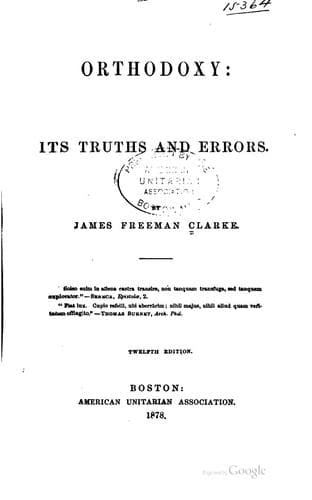
Orthodoxy: Its Truths And ErrorsClarke, James Freeman
Religion
Orthodoxy: Its Truths And Errors
Clarke, James Freeman
Unitarianism
These five texts from the apostle Paul seem to us very plain and
conclusive as to his opinions. But perhaps the strongest evidence in proof
of a universal restoration is to be found in Christ’s own parable of the
prodigal son. For in this the genuine spirit and purpose of the gospel is
shown to be that God _never_ loses his fatherly love for his rebellious
and lost children. On the contrary, his heart yearns towards them with a
more earnest affection than towards the holy and good. The prodigal son
represents those who are “dead in sin.” (Luke 15:24-32.) The parable
teaches that God loves them all the while they are away, and that “there
is more joy in heaven over one sinner that repenteth than over ninety and
nine just persons who need no repentance.” Now, if God loves the sinners
thus whose bodies are yet alive, does he cease to love them when the
bodily change takes place which we call death? Does his nature change
then? And if not, does it ever change? After millions of years, if they
have been lost and dead so long, has his love become weary of waiting, or
does “his mercy endure forever”?
To us it seems clear, that if the parable of the prodigal son is to be
taken as a true statement of the feeling of God towards every sinner, that
every sinner must at last be brought back by the mighty power of this
redeeming love. The power of the human will to resist God is indeed
indefinite; but the power of love is infinite. Sooner or later, then, in
the economy of the ages, all sinners must come back, in penitence and
shame, to their Father’s house, saying, “Make us as thy hired servants.”
If so, if universal restoration does not mean primarily restoration to
outward happiness, but to inward obedience, it seems to us that the
doctrine may be so stated as to be a new motive for _present_ repentance
and obedience. May we not say to the sinner, You may resist God to-day,
to-morrow, for a million years; but, sooner or later, you _must_ return,
obey, repent, and submit? God will spare no means to bring you. His love
to you requires him to use all methods, all terrors, all suffering. The
“worm that never dies,” the “fire that is never quenched,” the “outer
darkness,”—these are all blessed means, in the providence of the Almighty,
to bring the sinner back to a sense of his evil state. In the other world,
as in this world, God will “chasten us, not for his pleasure, but for our
profit, that we may be partakers of his holiness.”
CHAPTER XV. THE CHRISTIAN CHURCH.
§ 1. The Question stated.
Public-domain text, read in full here on John Shaqi.
Reviews
Reviews
No reviews yet
Be the first to share your thoughts on this work.
Elsewhere in the archive
Join the Discussion
Join the discussion
Sign in to leave a comment or review.
Sign InorCreate an account