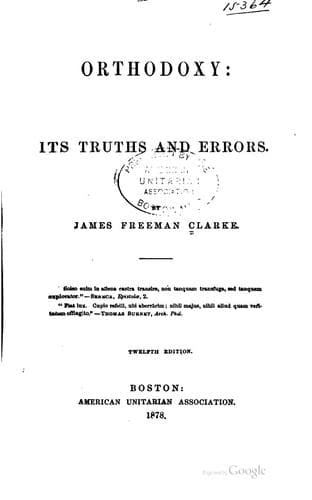
Orthodoxy: Its Truths And ErrorsClarke, James Freeman
Religion
Orthodoxy: Its Truths And Errors
Clarke, James Freeman
Unitarianism
The Ideal Church is an active Church. All the members work together for
the building up of the body; some after this fashion, others after that.
“So the whole body, fitly joined together, and compacted by that which
every joint supplieth,” is built up in love. Is there any ruinous vice,
any corroding sin, any festering moral disease in the land? The Ideal
Church searches for its root, and finds its cure. It takes the intemperate
man by the hand, and will not let him go till he abstains. It penetrates
into every haunt of sin and pollution, and brings forth the half-ruined
child, triumphantly leads out the corrupt woman, and places them in new
homes. The Ideal Church does not dispute about doctrines or dogmas. It
says to each, “To your Master you shall stand or fall, not to me.”
Therefore the Ideal Church is an earthly heaven. There is in it a warm,
serene, sunny atmosphere; a sky without clouds; the society of love, the
solitude of meditation, the inaccessible mountain tops of prayer; the
low-lying, quiet valleys, where the wicked cease from troubling, and the
weary are at rest.
But where is the Ideal Church? We have seen that it is not in the past,
where many look for it. The golden age of the Church, the Paradisiacal
state of Christianity, is not behind us. Was the Ideal Church that which
persecuted Paul for renouncing Judaism? Was it any of the Churches
described by John in the book of Revelation? that of Ephesus, which had
“left its first love”? that of Pergamos, which contained heretical
teachers? that of Thyatira, which communed with Jezebel and the depths of
Satan? that of Sardis, which had “a name to live, and was dead”? or that
of Laodicea, which was lukewarm?
Was that an Ideal Church where Paul was obliged to write to Titus that a
bishop must not be a striker, nor given to wine, nor to filthy lucre? and
to advise Timothy to avoid “profane and vain babbling”?
There was more life in it than in the Church now; a great struggling, but
undeveloped power of life, heaving and tossing the Church, as with
subterranean fire—smoke and flame bursting forth together; a great power
of life, but little chance of doctrine as yet; little harmony of action;
little in accordance with our ideas of decency and order. It was the
spring time, and as in the spring there is a great power of life in
nature, swelling all buds, pushing all shoots, unfolding leaves,—but all
things still bare; few flowers, no fruit,—so it was in the Primitive
Church. It was not Ideal. The Ideal Church is before us, not behind us; it
is to come.
§ 10. The Church Possible, or Church as it can be.
Is any Church possible but the Actual? We think there is. We think that a
Church may be something more and better than any we have now. Without
reaching the ideal standard we can yet do something.
Public-domain text, read in full here on John Shaqi.
Reviews
Reviews
No reviews yet
Be the first to share your thoughts on this work.
Elsewhere in the archive
Join the Discussion
Join the discussion
Sign in to leave a comment or review.
Sign InorCreate an account