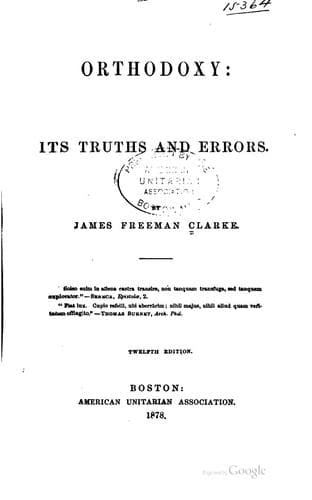
Orthodoxy: Its Truths And ErrorsClarke, James Freeman
Religion
Orthodoxy: Its Truths And Errors
Clarke, James Freeman
Unitarianism
Supreme power, wisdom, and goodness are manifested in nature as unchanging
law, as perfect order. But God is seen in Christ again as Redeemer, as
meeting the exigencies arising from the freedom of the creature by what we
call miracle; not contrary to nature, but different from nature, showing
himself as the Friend and Helper of the soul. As the essence of the first
revelation of God is the sight of his goodness, and wisdom, and power,
displayed in law, so the essence of the second revelation is of the same
essential Being displaying himself as love. In the first revelation, he is
the universal Parent; in the second, he is the personal Friend. But there
is a third revelation which God makes of himself,—within the soul as life.
The same power, wisdom, and goodness which we see displayed externally in
outward nature, we find manifested internally in the soul itself, as its
natural and its spiritual life. That which is displayed outwardly as power
is manifested within the soul as cause; that which is manifested outwardly
as wisdom is revealed inwardly as reason; and that which is manifested
outwardly as goodness is manifested inwardly as conscience, or the law of
right.
§ 5. It is in Harmony with Scripture.
The Scriptures also speak of the Father, the Son, and the Holy Ghost. When
they speak of the Father, they usually mean God as the Supreme Being.
Matt. 11:25: “Jesus said, I thank thee, _O Father_, Lord of heaven and
earth.” As omniscient: “Of that day knoweth no man, nor the angels, nor
the Son, but _the Father_ only.” As omnipotent: “Abba, _Father_, all
things are possible to thee.” As having life in himself, and as spirit:
“They shall worship _the Father_ in spirit and in truth.” As the source of
all power, life, and authority of the Son: “I came forth _of the Father_;”
“_the Father_, which hath sent me;” “the works which _the Father_ hath
given me to do.” The apostle Paul says, “To us there is but _one God, the
Father_;” and calls him “the God of our Lord Jesus;” also “the one God
_and Father_ of all, who is above all, and through all, and in us all.”
The great order of the universe depends on him: “He has put the times and
the seasons in his own power.” Christ will at last “deliver up the kingdom
to God, _the Father_.” By Christ, “we have access in one spirit _to the
Father_.” “All things were delivered” to Christ “of _his Father_,” whose
will Christ always sought. Thus is _the Father_ spoken of in the New
Testament as the Source from which all things have proceeded, and the End
to whom all things tend.
Public-domain text, read in full here on John Shaqi.
Reviews
Reviews
No reviews yet
Be the first to share your thoughts on this work.
Elsewhere in the archive
Join the Discussion
Join the discussion
Sign in to leave a comment or review.
Sign InorCreate an account