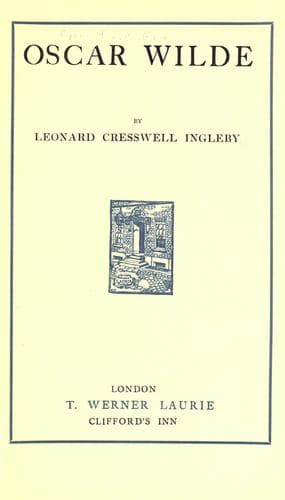
Authors, Irish -- 19th century -- Biography; Wilde, Oscar, 1854-1900
Here, strange to say, is the note of pathos which we hear again and
again in the volume of fairy stories which many men look upon as Oscar
Wilde's best and most characteristic prose work. Time after time they
make me murmur Vergil's untranslatable line _sunt lachrymæ rerum et
mentem mortalia tangunt_.
The felicity of expression is exquisite, and an opulent imagination
lavishes its treasures in every story. Our author has come into full
possession of his sovereignty of words and every sentence has its
carefully considered, yet spontaneous charm. Nevertheless, Oscar Wilde
makes the Linnet his mouthpiece in the fourth story "The Devoted
Friend." "'The fact is, that I told him a story with a moral.' 'Ah, that
is always a very dangerous thing to do,' said the Duck--and I quite
agreed with her."
Dangerous though it is, Oscar Wilde essayed the endeavour. I do not
think that children would easily detect that _amari aliquid_ which makes
the fairy stories fascinating to minds that are mature, and I am sure
that many little ones have revelled in the Swallow's stories of what he
had seen in strange lands when he told "the Happy Prince of the red
ibises, who stand in long rows on the banks of the Nile and catch gold
fish in their beaks; of the Sphinx, who is as old as the world itself,
and lives in the desert, and knows everything; of the merchants who walk
slowly by the side of their camels, and carry amber beads in their
hands; of the King of the Mountains of the Moon, who is as black as
ebony, and worships a large crystal; of the great green snake that
sleeps in a palm-tree, and has twenty priests to feed it with honey
cakes; and of the pygmies who sail over a big lake on large flat leaves,
and are always at war with the butterflies."
I suppose it would shock the authorities of the Education Department at
Whitehall if it were suggested that the children in the Elementary Day
Schools should have for their reading lesson, sometimes, the volume of
"The Happy Prince and Other Tales, by Oscar Wilde, illustrated by Walter
Crane and Jacomb Hood"--but I think the starved and stunted imaginations
of the children in the great, cruel cities would revive and grow if this
could be done.
But perhaps it would have to be an expurgated edition. The sad
consciousness of, and stern satire on, our social system might remain,
the children would take no hurt, and the weary school teachers would be
glad to hear and to read a children's fairy tale, which sets the student
thinking and makes the more worldly man consider his ways. But if I had
the editing of the book I would leave out here and there a sentence.
"'Bring me the two most precious things in the city,' said God to one of
His angels; and the angel brought him the leaden heart and the dead
bird.
Public-domain text, read in full here on John Shaqi.
Reviews
Reviews
No reviews yet
Be the first to share your thoughts on this work.
Elsewhere in the archive
Join the Discussion
Join the discussion
Sign in to leave a comment or review.
Sign InorCreate an account