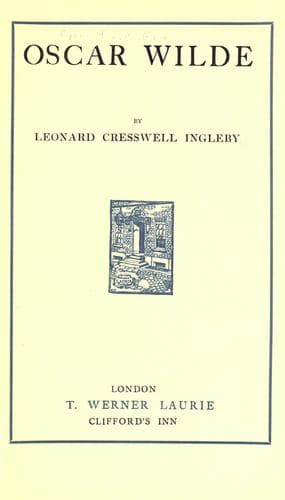
Authors, Irish -- 19th century -- Biography; Wilde, Oscar, 1854-1900
It is doubtful if readers will enjoy "The Remarkable Rocket" as they
will the other stories. The modern _milieu_ intrudes here and there. The
satire is keen and there are some clever epigrams. The Russian Princess
"had driven all the way from Finland in a sledge drawn by six reindeer
which was shaped like a great golden swan, and between the swan's wings
lay the little princess herself"--and we think that we are going to
enjoy again the atmosphere of Watteau, and are a little disappointed
when we find our author saying, "He was something of a politician, and
had always taken a prominent part in the local elections, or he knew the
proper Parliamentary expressions to use." And the story, alas! will
suggest over and over again painful thoughts which I would keep at a
distance when I read these other lovely tales. Was not this sentence of
evil omen? "'However, I don't care a bit,' said the Rocket. 'Genius like
mine is sure to be appreciated some day,' and he sank down a little
deeper into the mud." And the last sentence of all is terribly sinister.
"'I knew I should create a sensation,' gasped the Rocket, and he went
out."
"The House of Pomegranates" was published in 1891, and is dedicated to
Constance Mary Wilde. Here, in a volume which the author frankly calls a
volume of "Beautiful Tales," is a very stern indictment of the social
system which, in his essay "The Soul of Man," Oscar Wilde had so
powerfully denounced. We know how profoundly that essay has influenced
the minds of men in every country in Europe. Translated into every
tongue it has taught the oppressed to resent the callous cruelty of
capital, but I doubt if its author was altogether as earnest as he
seems. Here, in the story of the young King, we have a lighter touch. It
is as though the writer hesitated between two paths. In the year 1895
the wrong path had been taken if we may trust the record of a
conversation which took place in that year.
"To be a supreme artist," said he, "one must first be a supreme
individualist."
"You talk of Art," said I, "as though there were nothing else in the
world worth living for."
"For me," said he sadly, "there is nothing else."
But when Oscar Wilde dedicated "The House of Pomegranates" to his wife
the love of Beauty and the love of humankind still seemed to go
together.
Public-domain text, read in full here on John Shaqi.
Reviews
Reviews
No reviews yet
Be the first to share your thoughts on this work.
Elsewhere in the archive
Join the Discussion
Join the discussion
Sign in to leave a comment or review.
Sign InorCreate an account