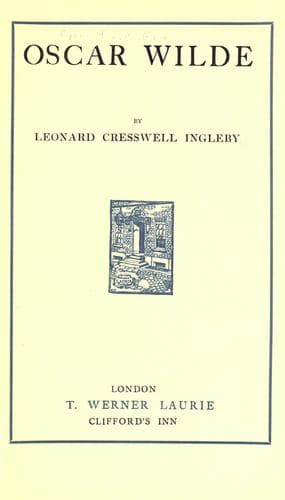
Authors, Irish -- 19th century -- Biography; Wilde, Oscar, 1854-1900
The Pope's captivity moved him again and again to express his
indignation in verse, and from his poem, "Easter Day" we can gather how
deeply he was impressed both by the stately ceremonial at St Peter's and
by the sight of the despoiled Pontiff. At this time also he seems to
have been more or less yearning after a more spiritual mode of life than
he has been leading, at least so one gathers from poems like "E
Tenebris" in which he tells us that--
"The wine of life is spilt upon the sand,
My heart is as some famine-murdered land
Whence all good things have perished utterly
And well I know my soul in Hell must be,
If I this night before God's throne should stand."
That he had visions of a possible time when a complete change should be
worked in his spiritual condition seems clear from the concluding lines
of "Rome Unvisited."
"Before yon field of trembling gold
Is garnered into dusty sheaves
Or ere the autumn's scarlet leaves
Flutter as birds adown the wold,
I may have run the glorious race,
And caught the torch while yet aflame,
And called upon the Holy name
Of Him who now doth hide His face."
Apart from the light these poems throw upon his mental and spiritual
attitude at that period, they are extremely interesting as revealing the
literary influences governing him at the time. I have already referred
to the resemblance between his sonnets and the more finished ones of
Dante Gabriel Rossetti, and this point cannot better be illustrated than
by placing the work of the two men in juxtaposition.
If we take, for instance, Rossetti's "Lady of the Rocks."
"Mother, is this the darkness of the end,
The Shadow of Death? and is that outer sea
Infinite imminent Eternity?
And does the death-pang by man's seed sustained
In Time's each instant cause thy face to bend
Its silent prayer upon the Son, while He
Blesses the dead with His hand silently
To His long day which hours no more offend?
Mother of grace, the pass is difficult,
Keen as these rocks, and the bewildered souls
Throng it like echoes, blindly shuddering through.
Thy name, O Lord, each spirit's voice extols,
Whose peace abides in the dark avenue
Amid the bitterness of things occult."
and compare it with "E Tenebris." We are at once struck with the same
mode of expression, the same train of thought and the same deep note of
pain in the two poems.
And again take Wilde's "Madonna Mia"--
Public-domain text, read in full here on John Shaqi.
Reviews
Reviews
No reviews yet
Be the first to share your thoughts on this work.
Elsewhere in the archive
Join the Discussion
Join the discussion
Sign in to leave a comment or review.
Sign InorCreate an account