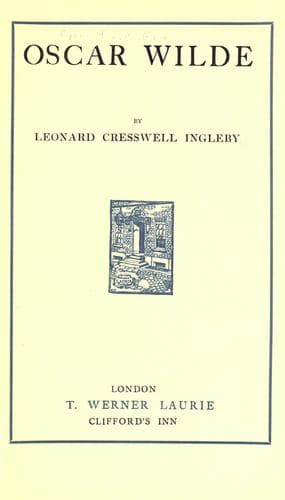
Authors, Irish -- 19th century -- Biography; Wilde, Oscar, 1854-1900
"A Serenade" and "Endymion" possess all the qualities that a musical
setting demands, but do not call for especial comment. It is, however,
in "La Bella Donna della mia Mante" that the expression of the poet's
genius finds vent.
"As a pomegranate, cut in twain,
White-seeded, is her crimson mouth"
is as perfect a metaphor as one could well wish to find.
"Charmides" is a more ambitious effort than anything he had yet
attempted. The word-painting is obviously inspired by Keats, for whose
work he had an intense admiration. Such lines as "Came a great owl with
yellow sulphurous eyes," and "Vermilion-finned with eyes of bossy gold"
might have been taken straight out of "Lamia," so truly has he caught
the spirit of his master. But if enamoured of Keats's gorgeous colouring
Wilde revelled in the construction of jewelled phrase and crimson line,
there is another source of inspiration noticeable in the poem. Had
Shakespeare never written "Venus and Adonis," Wilde might have written
"Charmides" but it would not have been the same poem. The difference
between the true poet who has studied the great verse of bygone ages and
the mere imitator is that one will produce a work of art enhanced by the
suggestions derived from the contemplation of the highest conception of
genius, whereas the other will outrun the constable and merely
accentuate and burlesque the distinguishing characteristics of the work
of others. In the case in point, whilst we note with pleasure and
interest the points of resemblance between the poem and the models that
its author has followed, we are conscious that what we are reading is a
work of art in itself and that its intrinsic merits are enhanced by the
points of resemblance and do not depend on them for their existence.
There is another poem--"Ballade de Marguerite"--which recalls memories
of Keats, closely resembling as it does "La Belle Dame Sans Merci."
Rarely has the old ballad form been more successfully treated. We catch
the very spirit of mediævalism in the lines--
"Perchance she is kneeling in St. Denys
(On her soul may our Lady have grammercy!)
Ah, if she is praying in lone chapelle
I might swing the censer and ring the bell."
It is so easy to overdo the thing, to produce a bad counterfeit made up
of Wardour Street English, that to retain the simplicity of language and
the slight _soupçon_ of Chaucerian English requires all the skill of a
master craftsman, and the intimate knowledge of the value and date of
words that can only result from a close acquaintance with the works of
the ballad writers.
In "The Dole of the King's Daughter" Wilde again essays the ballad form,
but this time the treatment shows more traces of the Rossetti influence.
The ballad spirit is maintained with unerring skill and the form
perfectly adhered to throughout. To quote good old Izaak
Walton--"old-fashioned poetry but choicely good."
Public-domain text, read in full here on John Shaqi.
Reviews
Reviews
No reviews yet
Be the first to share your thoughts on this work.
Elsewhere in the archive
Join the Discussion
Join the discussion
Sign in to leave a comment or review.
Sign InorCreate an account