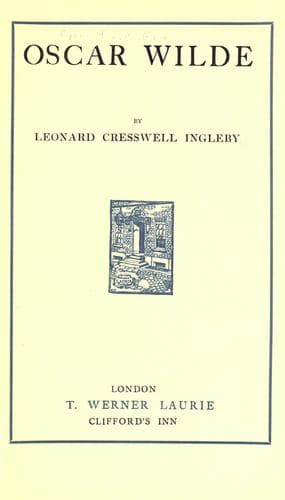
Authors, Irish -- 19th century -- Biography; Wilde, Oscar, 1854-1900
"Whatever spiritual message an artist brings to his age, it is for
us to do naught but accept his teaching. You have most of you seen
probably that great masterpiece of Rubens which hangs in the
gallery of Brussels, that swift and wonderful pageant of horse and
rider, arrested in its most exquisite and fiery moment, when the
winds are caught in crimson banner and the air is lit by the gleam
of armour and the flash of plume. Well, that is joy in art, though
that golden hillside be trodden by the wounded feet of Christ; and
it is for the death of the Son of Man that that gorgeous cavalcade
is passing.
"In the primary aspect a painting has no more spiritual message
than an exquisite fragment of Venetian glass. The channels by which
all noble and imaginative work in painting should touch the soul
are not those of the truths of lives. This should be done by a
certain inventive and creative handling entirely independent of
anything definitely poetical in the subject, something entirely
satisfying in itself, which is, as the Greeks would say, in itself
an end. So the joy of poetry comes never from the subject, but
from an inventive handling of rhythmical language."
And further he said that "in nations as in individuals, if the passion
for creation be not accompanied by the critical, the æsthetic faculty
also, it will be sure to waste its strength. It is not an increased
moral sense or moral supervision that your literature needs. Indeed one
should never talk of a moral or immoral poem. Poems are either well
written or badly written; that is all. Any element of morals or implied
reference to a standard of good and evil in art is often a sign of a
certain incompleteness of vision. All good work aims at a purely
artistic effect."
In "Intentions" he enunciated serious problems which seemed constantly
to contradict themselves, and he causes ourselves to ask questions which
only bewilder and astonish. To sum up all the æsthetic teaching of the
author it amounts simply and solely to the aphorism that there must be a
permanent divorce between art and morals. "All art," he says, "is
immoral."
Public-domain text, read in full here on John Shaqi.
Reviews
Reviews
No reviews yet
Be the first to share your thoughts on this work.
Elsewhere in the archive
Join the Discussion
Join the discussion
Sign in to leave a comment or review.
Sign InorCreate an account