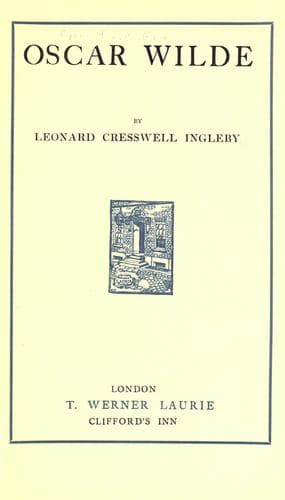
Authors, Irish -- 19th century -- Biography; Wilde, Oscar, 1854-1900
It was not in this way, so said the writer in _The Times_, that souls
were laid bare, this was not sorrow, but the most dextrous counterfeit
of sorrow. Wilde, so the review stated, was "probably unable to cry from
the depths at all." His book simply showed that there was an armour of
egotism which no arrow of fate was able to pierce. Even in "De
Profundis" the poseur supplemented the artist, and the truth was not in
him. If the heart of a broken man showed at all in the book it must,
said _The Times_, "be looked for between the lines. It was rarely in
them."
In short, so the review, when summed up and crystallised, implied, Wilde
was incapable of telling the truth about himself, or about anything at
all. Sometimes in his writings he fell upon the truth by accident, and
then his works contained a modicum of truth. Consciously, he was never
able to discover it, consciously, he was never able to enunciate it.
Now, that is a point of view which is natural enough, but which, after
careful study, I cannot substantiate in any way. Over and over again
the same thing was said. Everybody was prepared, at last, to admit that
Wilde was a great artist--in direct contradiction to that condemnation
of even his literary power which was poured upon his works at the time
of his downfall--but the general opinion of the leading critics seemed
to point to the fact of "De Profundis" being a pose and insincere.
Now, if the book was merely an excursion in attitude, a considered work
of art without any very profound relation to the truth of its personal
psychology, then I think the book would be a less saddening thing than
it undoubtedly is. Surely, the author had a perfect right, if he so
wished, to produce a psychological romance. This I know is not a
generally held opinion, but I do not see how anybody who knows anything
about the brain of the artist and the ethics of creation can really deny
it. If the work is absolutely sincere, as I believe it to be, then, from
the moral point of view, it is indeed a terrible document. It shows us
how little the extraordinary, complex temperament of Oscar Wilde was
really chastened and purified. It provides us with a moral picture of
monstrous egotism set in a frame of jewels.
As has been said so often before in this book, the worse and insane side
of Oscar Wilde must always obscure and conquer the better and beautiful
side of him.
Public-domain text, read in full here on John Shaqi.
Reviews
Reviews
No reviews yet
Be the first to share your thoughts on this work.
Elsewhere in the archive
Join the Discussion
Join the discussion
Sign in to leave a comment or review.
Sign InorCreate an account