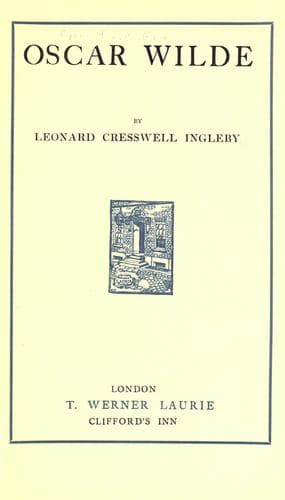
Authors, Irish -- 19th century -- Biography; Wilde, Oscar, 1854-1900
Wilde, in fact, definitely states that the artistic life means for him
the tasting in turn of good and evil, the entertainment of saints and
devils, for the sake of extending the circle of his friends. He
approaches the Personality of Christ _sub specie artis_, and only in
this way, and his words are the more terrible to the devout Christian
because they are so beautiful. Do we not remember, indeed, that once
when a young man knelt to our Lord and called Him "good," the Saviour
put him aside? Does it not strike one that there is something very
nearly blasphemous in the man who had lived the consciously antinomian
life that Oscar Wilde lived daring to call the Saviour idyllic, poetic,
dramatic, charming, fascinating? Does not the poet use the personality
of our Lord as a mere peg on which to hang his own gorgeous and jewelled
imagery, a reed through which he should make his own artistic music? Our
Lord did not come into the world to win admiration but to win the soul
from sin. His appeal was not to our imagination, but to our dormant
souls to rouse and strengthen them.
Oscar Wilde writes of Jesus, but there is no Cross. There is a Saviour,
but no repentance, no renewal, of life, no effort after Holiness.
It is terrible, indeed, to think of the poor unhappy author striving to
appreciate Jesus, though surely even his blind semi-appreciation of the
Personality of our Lord was better than none at all, and then to know
that even the little germ of truth which seemed to have come into his
life was forgotten and pushed away when once more the "appreciator" of
Jesus of Nazareth returned to the world.
As an English minister pointed out, the moral of Wilde's attitude
towards the Christian Faith is as old as Scripture itself, and as modern
as Browning also, who, in the painter's question--"gave art, and what
more wish you?" replied--
"To become now self-acquainters,
And paint man, man, whatever the issue,
Make new hopes shine through the flesh they fray,
New fears aggrandise the rags and tatters,
To bring the invisible full into play,
Let the visible go to the dogs--what matters?"
* * * * *
Public-domain text, read in full here on John Shaqi.
Reviews
Reviews
No reviews yet
Be the first to share your thoughts on this work.
Elsewhere in the archive
Join the Discussion
Join the discussion
Sign in to leave a comment or review.
Sign InorCreate an account