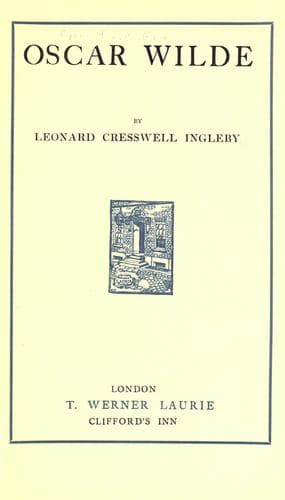
Authors, Irish -- 19th century -- Biography; Wilde, Oscar, 1854-1900
equally simple and effective way of achieving that purpose.
A favourite device of the author was to introduce, apparently casually,
a sentence or word at the beginning of the play to be repeated or used
with telling effect at the end. For instance, in "A Woman Of No
Importance" Lord Illingworth's casual remark--"Oh, no one--a woman of no
importance," which brings down the curtain on the first act, is used
with a slight alteration at the end of the play in Mrs Arbuthnot's reply
to Gerald's inquiry as to who her visitor has been, "Ah, no one--a man
of no importance." In the same way Salomé's reiterated cry, "I will kiss
the mouth of Jokanaan," in her scene with the prophet gives added
strength to her bitterly triumphant cry as, holding the severed head in
her hands, she repeats at three different intervals, "I have kissed thy
mouth, Jokanaan."
Apart from all questions of stage technique, Wilde had the incomparable
gift of finding _le mot juste_, of conveying a portrait in half-a-dozen
words. Could anything give one a more distinct portrait of Herod than
Salomé's description of his "mole's eyes under his shaking eyelids," or
would it be possible to explain Herod's passion for his stepdaughter in
fewer words than her soliloquy: "It is strange that the husband of my
mother looks at me like that. I know not what it means. In truth, yes, I
know it." There is not a word wasted or misplaced, there is not a
superfluous syllable.
I have spoken of the influence of Flaubert or his language, but there
was in Wilde a thoroughly Eastern love of colour which found its
expression in sensuous richness of sound, jewelled words, wonderfully
employed to effect a contrast with the horror in which he seemed to take
a strange delight. The rich, decorative phrases only enhance the
constant presence of the weird and _macabre_, while in its turn the
horror gives an almost painful lustre to the words.
The play has been assailed as immoral, but this certainly is not so. The
setting of an Eastern drama is not that of a Western, and the morals and
customs of the East are no more to be judged by a Western standard than
the Court of Herod to be compared with that of Edward the Seventh.
The play deals frankly with a sensuous episode, and if the author has
introduced the proper atmosphere he is only doing in words what every
artist does in painting. Compare "Salomé" with Shakespeare's one Eastern
play, "Cleopatra," and though the treatment may be a little more modern,
a trifle more decadent, the same non-morality rather than immorality is
to be found in the principal characters.
Public-domain text, read in full here on John Shaqi.
Reviews
Reviews
No reviews yet
Be the first to share your thoughts on this work.
Elsewhere in the archive
Join the Discussion
Join the discussion
Sign in to leave a comment or review.
Sign InorCreate an account