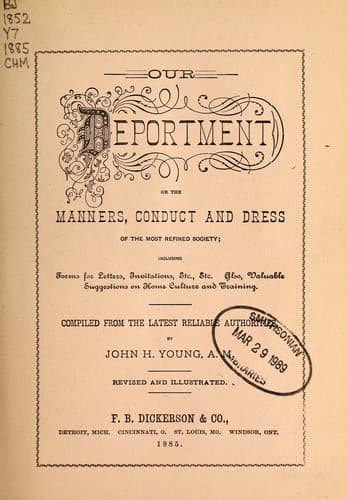
Our Deportment: Or the Manners, Conduct and Dress of the Most Refined SocietyYoung, John H.
General
Our Deportment: Or the Manners, Conduct and Dress of the Most Refined Society
Young, John H.
Etiquette
_Mrs. S.M. Thomas,_
_Care of_ _St. Louis,_
_H.H. Johnson_ _Mo._]
In sending a letter by a friend or acquaintance, and not through the
mail, acknowledge the courtesy of your friend on the envelope. The
letter should not be sealed. The following is the proper form:
[Illustration:
_Mrs. Julia C. Wheeler,_
_734 Simson Street,_
_Kindness (or Politeness) of_ _Dayton,_
_James Steinfield._ _Ohio._]
A note or letter sent to a friend residing in the same place, by a
messenger, may be addressed as follows, or bear the full address:
[Illustration:
_Miss Mary Wyman,_
_Presented._]
FORM OF A LETTER.
[Illustration:
_Denver, May 13, 1881._
_My Esteemed Friend:_
_I received your very good letter, and hasten to
reply. I am overjoyed at the prospects of a speedy
return to the ancient, but delightful "City of the
Straits," and anticipate spending a pleasant summer
with you and my many friends. We are making
preparations to leave June 5th._
_Your old friend,_
_Joe J. Wilson_
_Geo. W. Smyth,_
_Detroit, Mich._]
DEGREES OF FORMALITY OBSERVED.
In commencing and signing notes and letters there is a difference of
opinion in the degrees of formality to be observed, but generally this
scale is used according to the degree of acquaintance or friendship.
"Madam" or "Sir," "Dear Madam" or "Dear Sir," "My Dear Madam" or "My
Dear Sir," "Dear Mrs. Brown" or "Dear Mr. Brown," "My Dear Mrs. Brown"
or "My Dear Mr. Brown," "My Dear Friend." In closing a note, the degrees
are implied as follows: "Truly Yours" or "Yours Truly," "Very Truly
Yours," "Sincerely Yours," "Cordially Yours," "Faithfully Yours,"
"Affectionately Yours." The proper words should be carefully selected,
as the conclusion of a note or letter makes an impression on the person
reading it. To aged persons the form, "With great respect, sincerely
yours," recommends itself as a proper form. "Yours, etc.," is considered
a rude ending. If you are sufficiently well acquainted with a person to
address her "My Dear Mrs. ----," do not sign "Yours Truly," or "Truly
Yours," as this is the form to be used in writing to strangers or in
business letters.
SIGNATURE OF LADIES.
A married lady should not sign herself with the "Mrs." before her
baptismal name, or a single lady with the "Miss." In writing to
strangers who do not know whether to address you as Mrs. or Miss, the
address should be given in full, after signing your letter; as "Mrs.
John Smith," followed by the direction; or if unmarried, the "Miss"
should be placed in brackets a short distance preceding the signature.
Public-domain text, read in full here on John Shaqi.
Reviews
Reviews
No reviews yet
Be the first to share your thoughts on this work.
Elsewhere in the archive
Join the Discussion
Join the discussion
Sign in to leave a comment or review.
Sign InorCreate an account