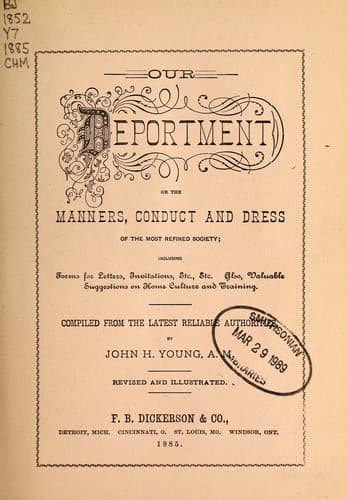
Our Deportment: Or the Manners, Conduct and Dress of the Most Refined SocietyYoung, John H.
General
Our Deportment: Or the Manners, Conduct and Dress of the Most Refined Society
Young, John H.
Etiquette
The invitation to a large party is similar to that for a ball, only the
words "at a ball" are omitted, and the hour may be earlier. The notes of
acceptance and regret are the same as for a ball. If the party is a
small one, it should be indicated by inserting the words, "to a small
evening party," so that there may be no misunderstanding. A large party
calls for full evening dress, and it would be embarrassing for a lady or
gentleman to go to a house in full evening dress, expecting to find a
large party there in similar costumes, and meet only a few friends and
acquaintances plainly dressed. If there is any special feature which is
to give character to the evening, it is best to mention this fact in the
note of invitation. Thus the words "musical party," "to take part in
dramatic readings," "amateur theatricals," will denote the character of
the evening's entertainment. If you have programmes, enclose one in the
invitation.
INVITATION TO A PUBLIC ENTERTAINMENT.
An invitation from a gentleman to a lady to attend a concert, lecture,
theatre, opera or other amusement, may read as follows:
"Mr. Hayden would be pleased to have Miss Morton's
company to the Academy of Music, on Monday
evening, November 8, when 'Richelieu' will be
played by Edwin Booth's Company."
An invitation of this kind demands an immediate answer of acceptance or
regrets. A previous engagement may be a reason for rejection.
DINNER INVITATIONS.
These are written in the name of the husband and wife, and demand an
immediate reply. This form may be used:
"Mr. and Mrs. Eugene Snow request the pleasure of
Mr. and Mrs. Horace Allen's company at dinner, on
Tuesday, the 13th of January, at 7 o'clock."
A note of acceptance may read as follows:
"Mr. and Mrs. Horace Allen accept with pleasure
Mr. and Mrs. Eugene Snow's kind invitation to dine
with them on Tuesday, the 13th inst., at 7
o'clock."
A note of regret may read:
"Mr. and Mrs. Horace Allen regret exceedingly that
sickness in the family (or whatever the cause may
be) prevents the acceptance of Mr. and Mrs. Eugene
Snow's kind invitation to dine with them on
Tuesday, January 13th."
INVITATIONS TO TEA.
An invitation to a tea-drinking may be less formal and should partake
more of the nature of a private note; thus:
"Dear Miss Brock: Some friends are coming to drink
tea with me on Thursday, and I should be glad of
the pleasure of your company also. Please do not
disappoint me."
An invitation of this informal nature needs no reply, unless "R.S.V.P."
is appended, in which case the answer must be returned, if possible, by
the messenger who brought it, or sent at once, as your friend may depend
upon having a certain number of people at her tea-drinking, and if you
cannot go, she will want to supply your place.
Public-domain text, read in full here on John Shaqi.
Reviews
Reviews
No reviews yet
Be the first to share your thoughts on this work.
Elsewhere in the archive
Join the Discussion
Join the discussion
Sign in to leave a comment or review.
Sign InorCreate an account