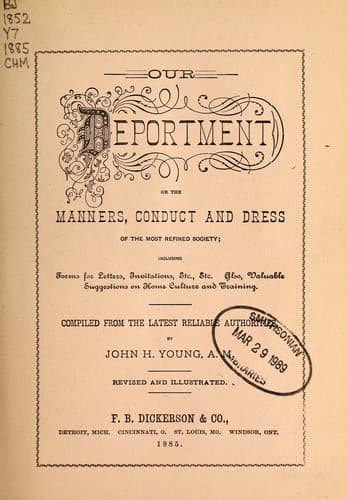
Our Deportment: Or the Manners, Conduct and Dress of the Most Refined SocietyYoung, John H.
General
Our Deportment: Or the Manners, Conduct and Dress of the Most Refined Society
Young, John H.
Etiquette
Never enter a private room anywhere without knocking. Sacredly respect
the private property of others, and let no curiosity tempt you to pry
into letters, desks, packets, trunks, or other belongings of another. It
is ill-mannered to read a written paper lying upon a table or desk;
whatever it may be, it is certainly no business of yours. No person
should ever look over the shoulder of another who is reading or writing.
You must not question a servant or child upon family affairs. Never
betray an implied confidence, even if you have not been bound to
secrecy.
KEEPING ENGAGEMENTS.
Nothing is more rude than to make an engagement, be it of business or
pleasure, and break it. If your memory is not sufficiently retentive to
keep all the engagements you make, carry a little memorandum book, and
enter them there.
VALUE OF POLITENESS.
Chesterfield says: "As learning, honor and virtue are absolutely
necessary to gain you the esteem and admiration of mankind, politeness
and good-breeding are equally necessary to make you welcome and
agreeable in conversation and common life. Great talents, such as honor,
virtue, learning and arts, are above the generality of the world, who
neither possess them themselves, nor judge of them rightly in others;
but all people are judges of the lesser talents, such as civility,
affability, and an obliging, agreeable address and manner; because they
feel the good effects of them, as making society easy and pleasing."
ADAPTING YOURSELF TO OTHERS.
Conform your conduct as far as possible to the company you chance to be
with, only do not throw yourself into improper company. It is better
even to laugh at and join in with vulgarity, so that it do not
degenerate into indecency, than to set yourself up as better, and
better-mannered than those with whom you may chance to be associated.
True politeness and genuine good manners often not only permit but
absolutely demand a temporary violation of the ordinary obligations of
etiquette.
A WOMAN'S GOOD NAME.
Let no man speak a word against a woman at any time, or mention a
woman's name in any company where it should not be spoken. "Civility,"
says Lord Chesterfield, "is particularly due to all women; and remember
that no provocation whatsoever can justify any man in not being civil to
every woman; and the greatest man would justly be reckoned a brute if
he were not civil to the meanest woman. It is due to their sex, and is
the only protection they have against the superior strength of ours."
DO NOT CONTRADICT.
Never directly contradict anyone. Say, "I beg your pardon, but I think
you are mistaken or misinformed," or some such similar phrase which
shall break the weight of direct contradiction. Where the matter is
unimportant it is better to let it pass without correction.
EXPRESSING UNFAVORABLE OPINIONS.
Public-domain text, read in full here on John Shaqi.
Reviews
Reviews
No reviews yet
Be the first to share your thoughts on this work.
Elsewhere in the archive
Join the Discussion
Join the discussion
Sign in to leave a comment or review.
Sign InorCreate an account