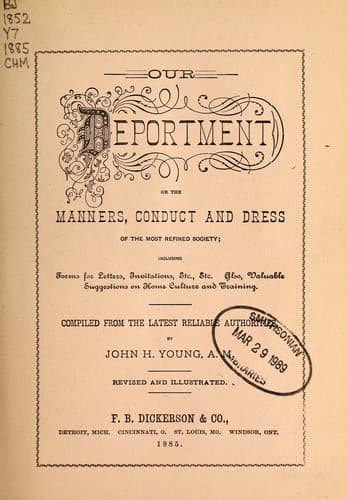
Our Deportment: Or the Manners, Conduct and Dress of the Most Refined SocietyYoung, John H.
General
Our Deportment: Or the Manners, Conduct and Dress of the Most Refined Society
Young, John H.
Etiquette
Never answer another rudely or impatiently. Reply courteously, at
whatever inconvenience to yourself.
Never intrude upon a business man or woman in business hours unless you
wish to see them on business.
Never engage a person in private conversation in presence of others, nor
make any mysterious allusions which no one else understands.
On entering a room, bow slightly as a general salutation, before
speaking to each of the persons assembled.
Do not seem to notice by word or glance, the deformity of another.
To administer reproof to anyone in the presence of others is very
impolite. To scold at any time is unwise.
Never undertake a commission for a friend and neglect to perform it.
Never play a practical joke upon anyone, or answer a serious remark by a
flippant one.
Never lend a borrowed book, and never keep such a book a single day
after you are done with it.
Never pass between two persons who are talking together; and never pass
before persons when it is possible to pass behind them. When such an act
is absolutely necessary, always apologize for so doing.
"Never speak of a man's virtues before his face, or his faults behind
his back," is a maxim to be remembered.
Another maxim is, "In private watch your thoughts; in your family watch
your temper; in society watch your tongue."
Never address a mere acquaintance by his or her Christian name. It is a
presumption at which the acquaintance may take offense.
Haughtiness and contempt are among the habits to be avoided. The best
way is to deal courteously with the rude as well as with the courteous.
In the presence of others, talk as little of yourself as possible, or of
the business or profession in which you are engaged.
It shows a want of courtesy to consult your watch, either at home or
abroad. If at home, it appears as though you were tired of your company,
and wished them to be gone. If abroad, it appears as though the hours
dragged heavily, and you were calculating how soon you would be
released.
Do not touch or handle any of the ornaments in the house where you
visit. They are intended to be admired, not handled by visitors.
Do not read in company. A gentleman or lady may, however, look over a
book of engravings or a collection of photographs with propriety.
Every species of affectation should be avoided, as it is always
detected, and exceedingly disagreeable.
WASHINGTON'S MAXIMS.
Mr. Sparks, in his biography of Washington, has given to the public a
collection of Washington's directions as to personal conduct, which he
called his "Rules of Civility and Decent Behavior in Company." We give
these rules entire, as the reader may be interested in learning the
principles which governed the conduct of the "Father of his Country."
Every action in company ought to be with some sign of respect to those
present.
In the presence of others sing not to yourself with a humming voice, nor
drum with your fingers or feet.
Public-domain text, read in full here on John Shaqi.
Reviews
Reviews
No reviews yet
Be the first to share your thoughts on this work.
Elsewhere in the archive
Join the Discussion
Join the discussion
Sign in to leave a comment or review.
Sign InorCreate an account