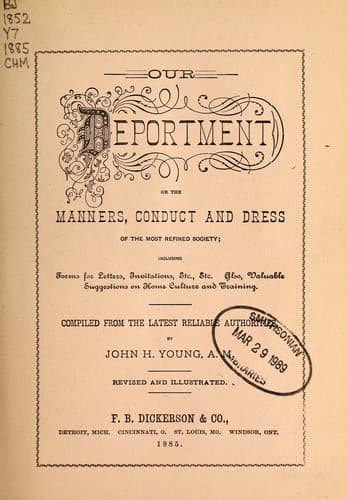
Our Deportment: Or the Manners, Conduct and Dress of the Most Refined SocietyYoung, John H.
General
Our Deportment: Or the Manners, Conduct and Dress of the Most Refined Society
Young, John H.
Etiquette
It becomes an all-important matter to the parents, what name they shall
give to the newly-born child, and as this is a matter which may also
concern the latter at some future day, it becomes an object of
solicitude, until a suitable name is settled upon. The custom in
Scotland is to name the first son after the father's father, and the
first daughter after the mother's mother, the second son after the
father, the second daughter after the mother, and succeeding children
after other near relations. This perpetuates family names, and if they
are persons whose names are regarded as worthy of perpetuation, it may
be considered a good custom to follow. With some it is customary to name
children after some renowned person, either living or dead. There are
objections to this plan, however, for if the person be still living, he
may commit some act which will bring opprobrium to his name, and so
cause both the parent and child to be ashamed of bearing such a
disgraced name. If the person after whom the child is named be dead, it
may be that the child's character may be so entirely different from the
person who formerly bore it, that the name shall be made a reproach or
satire.
The plan of reviving the old Saxon names has been adopted by some, and
it has been claimed that the names of Edgar, Edwin, Arthur, Alfred,
Ethel, Maud, Edith, Theresa, and many others of the Saxon names are
pleasant sounding and strong, and a desirable contrast to the Fannies,
Mamies, Minnies, Lizzies, Sadies, and other petty diminutives which have
taken the place of better sounding and stronger names.
THE CHRISTENING.
The christening and the baptism usually occur at the same time, and are
regulated according to the practices of the special church where the
parents attend worship. As these are quite varied, it will be sufficient
only to indicate the forms and customs which society imposes at such
times.
GODPARENTS OR SPONSORS.
In the Episcopal Church there are two, and sometimes three, godparents
or sponsors. If the child is a boy, there are two godfathers and one
godmother. If a girl, two godmothers and one godfather. The persons
selected for godparents should be near relatives or friends of long and
close standing, and should be members of the same church into which the
child is baptized. The maternal grandmother and paternal grandfather
usually act as sponsors for the first child, the maternal grandfather
and paternal grandmother for the second. A person invited to act as
godparent should not refuse without good reason. If the grandparents are
not selected, it is an act of courtesy to select the godmother, and
allow her to designate the godfather. Young persons should not stand
sponsors to an infant; and none should offer to act unless their
superior position warrants them in so doing.
PRESENTS FROM GODFATHERS.
Public-domain text, read in full here on John Shaqi.
Reviews
Reviews
No reviews yet
Be the first to share your thoughts on this work.
Elsewhere in the archive
Join the Discussion
Join the discussion
Sign in to leave a comment or review.
Sign InorCreate an account