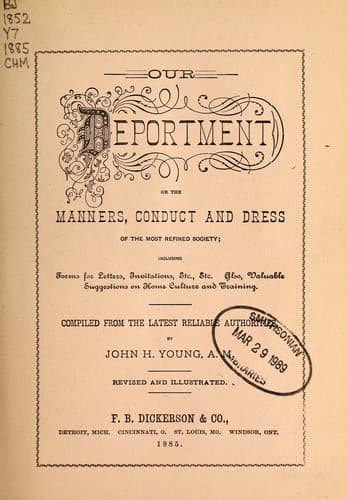
Our Deportment: Or the Manners, Conduct and Dress of the Most Refined SocietyYoung, John H.
General
Our Deportment: Or the Manners, Conduct and Dress of the Most Refined Society
Young, John H.
Etiquette
Visiting costumes, or those worn at a funeral or informal calls, are of
richer material than walking suits. The bonnet is either simple or rich,
according to the taste of the wearer. A jacket of velvet, or shawl, or
fur-trimmed mantle are the concomitants of the carriage dress for
winter. In summer all should be bright, cool, agreeable to wear and
pleasant to look at.
DRESS FOR MORNING CALLS.
Morning calls may be made either in walking or carriage dress, provided
the latter is justified by the presence of the carriage. The dress
should be of silk; collar and cuffs of the finest lace; light gloves; a
full dress bonnet and jewelry of gold, either dead, burnished or
enameled, or of cameo or coral. Diamonds are not usually worn in
daylight. A dress of black or neutral tint, in which light colors are
introduced only in small quantities, is the most appropriate for a
morning call.
MORNING DRESS FOR STREET.
The morning dress for the street should be quiet in color, plainly made
and of serviceable material. It should be short enough to clear the
ground without collecting mud and garbage. Lisle-thread gloves in
midsummer, thick gloves in midwinter, are more comfortable for street
wear than kid ones. Linen collars and cuffs are most suitable for
morning street dress. The bonnet and hat should be quiet and
inexpressive, matching the dress as nearly as possible. In stormy
weather a large waterproof with hood is more convenient and less
troublesome than an umbrella. The morning dress for visiting or
breakfasting in public may be, in winter, of woolen goods, simply made
and quietly trimmed, and in summer, of cambric, pique, marseilles or
other wash goods, either white or figured. For morning wear at home the
dress may be still simpler. The hair should be plainly arranged without
ornament.
THE PROMENADE DRESS.
The dress for the promenade should be in perfect harmony with itself.
All the colors worn should harmonize if they are not strictly identical.
The bonnet should not be of one color, and parasol of another, the dress
of a third and the gloves of a fourth. Nor should one article be new and
another shabby. The collars and cuffs should be of lace; the kid gloves
should be selected to harmonize with the color of the dress, a perfect
fit. The jewelry worn should be bracelets, cuff-buttons, plain gold
ear-rings, a watch chain and brooch.
OPERA DRESS.
Opera dress for matinees may be as elegant as for morning calls. A
bonnet is always worn even by those who occupy boxes, but it may be as
dressy as one chooses to make it. In the evening, ladies are at liberty
to wear evening dresses, with ornaments in their hair, instead of a
bonnet, and as the effect of light colors is much better than dark in a
well-lighted opera house, they should predominate.
THE RIDING DRESS.
Public-domain text, read in full here on John Shaqi.
Reviews
Reviews
No reviews yet
Be the first to share your thoughts on this work.
Elsewhere in the archive
Join the Discussion
Join the discussion
Sign in to leave a comment or review.
Sign InorCreate an account