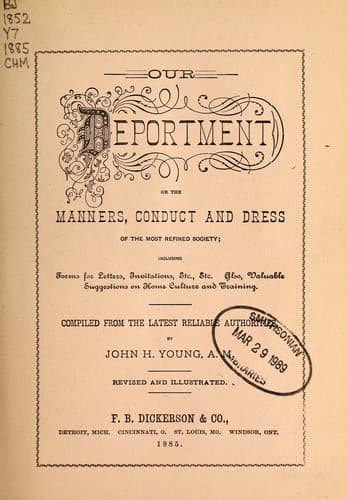
Our Deportment: Or the Manners, Conduct and Dress of the Most Refined SocietyYoung, John H.
General
Our Deportment: Or the Manners, Conduct and Dress of the Most Refined Society
Young, John H.
Etiquette
A well formed foot is broad at the sole, the toes well spread, each
separate toe perfect and rounded in form. The nails are regular and
perfect in shape as those of the fingers. The second toe projects a
little beyond the others, and the first, or big toe, stands slightly
apart from the rest and is slightly lifted. The feet, from the
circumstance of their being so much confined by boots and shoes, require
more care in washing than the rest of the body. Yet they do not always
get this care. The hands receive frequent washings every day. Once a
week is quite as often as many people can bestow the same attention upon
their feet. A tepid bath at about 80 or 90 degrees, should be used. The
feet may remain in the water about five minutes, and the instant they
are taken out they should be rapidly and thoroughly dried by being well
rubbed with a coarse towel. Sometimes bran is used in the water. Few
things are more invigorating and refreshing after a long walk, or
getting wet in the feet, than a tepid foot-bath, clean stockings and a
pair of easy shoes. After the bath is the time for paring the toe-nails,
as they are so much softer and more pliant after having been immersed in
warm water.
TREATMENT FOR MOIST OR DAMP FEET.
Some persons are troubled with moist or damp feet. This complaint arises
more particularly during the hot weather in summer-time, and the
greatest care and cleanliness should be exercised in respect to it.
Persons so afflicted should wash their feet twice a day in soap and warm
water, after which they should put on clean socks. Should this fail to
cure, they may, after being washed as above, be rinsed, and then
thoroughly rubbed with a mixture consisting of half a pint of warm water
and three tablespoonfuls of concentrated solution of chloride of soda.
BLISTERS ON THE FEET.
People who walk much are frequently afflicted with blisters. The best
preventative of these is to have easy, well-fitting boots and woolen
socks. Should blisters occur, a very good plan is to pass a large
darning-needle threaded with worsted through the blister lengthwise,
leaving an inch or so of the thread outside at each end. This keeps the
scurf-skin close to the true skin, and prevents any grit or dirt
entering. The thread absorbs the matter, and the old skin remains until
the new one grows. A blister should not be punctured save in this
manner, as it may degenerate into a sore and become very troublesome.
CHILBLAINS.
Public-domain text, read in full here on John Shaqi.
Reviews
Reviews
No reviews yet
Be the first to share your thoughts on this work.
Elsewhere in the archive
Join the Discussion
Join the discussion
Sign in to leave a comment or review.
Sign InorCreate an account