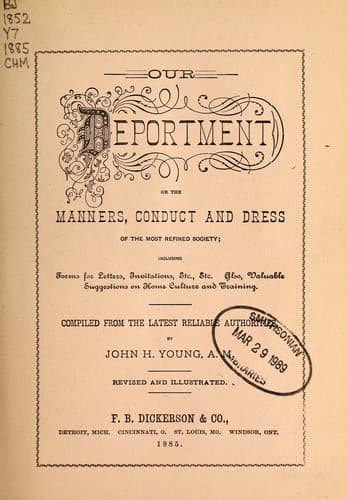
Our Deportment: Or the Manners, Conduct and Dress of the Most Refined SocietyYoung, John H.
General
Our Deportment: Or the Manners, Conduct and Dress of the Most Refined Society
Young, John H.
Etiquette
Private theatricals may be made very pleasing and instructive
entertainments for fall or winter evenings, among either young or
married people. They include charades, proverbs, tableaux, dramatic
readings, and the presentation of a short dramatical piece, and may
successfully be given in the parlor or drawing room. The hostess seeks
the aid of friends in the preparation of her arrangements, and if a
drama has been determined upon, she assigns the various parts to each.
Her friends should aid her in her efforts by giving her all the
assistance they can, and by willingly and good-naturedly complying with
any request she may make, accepting the parts allotted to them, even if
they are obscure or distasteful. They should endeavor to perform their
part in any dramatical piece, tableau or charade as well as possible,
and the success they achieve will determine how conspicuous a part they
may be called upon to perform at a subsequent time. The hostess should
consult each performer before alloting a part, and endeavor to suit each
one. The host or hostess should not have any conspicuous part assigned
them, unless it is urged by all the other performers. Those who are to
participate, should not only learn their parts, but endeavor to imbue
themselves with the spirit of the character they personate, so as to
afford pleasure to all who are invited to witness its performance. When
persons have consented to participate in any such entertainment, only
sickness or some very grave cause should prevent them from undertaking
their part. Supper or refreshments usually follow private theatricals,
of which both the performers and invited guests are invited to partake,
and the remainder of the evening is spent in social intercourse.
ETIQUETTE OF CARD PLAYING.
Never urge any one who seems to be unwilling to play a game of cards.
They may have conscientious scruples in the matter, which must be
respected.
If you have no scruples of conscience, it is not courteous to refuse,
when a game cannot be made up without you.
You may refuse to play if you do not understand the game thoroughly. If,
however, you are urged to try, and your partner and opponents offer to
instruct you, you may accede to their requests, for in so doing, you
will acquire a better knowledge of the game.
Married and elderly people take precedence over young and unmarried
people, in a game of cards.
It is the privilege of the host and hostess to suggest cards as a means
of amusement for the guests. The latter should never call for them.
"Whist" is a game of cards so-called, because it requires silence and
close attention. Therefore in playing this game, you must give your
whole attention to the cards, and secure at least comparative silence.
Do not suggest or keep up any conversation during a game, which will
distract your own mind or the mind of others from the game.
Never hurry any one who is playing. In endeavoring to play their best,
they should take their own time, without interruption.
Public-domain text, read in full here on John Shaqi.
Reviews
Reviews
No reviews yet
Be the first to share your thoughts on this work.
Elsewhere in the archive
Join the Discussion
Join the discussion
Sign in to leave a comment or review.
Sign InorCreate an account