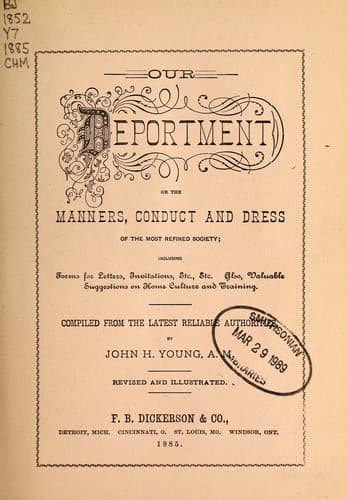
Our Deportment: Or the Manners, Conduct and Dress of the Most Refined SocietyYoung, John H.
General
Our Deportment: Or the Manners, Conduct and Dress of the Most Refined Society
Young, John H.
Etiquette
It must be remembered that a social gathering should never be made the
arena of a dispute. Consequently every subject liable to provoke a
discussion should be avoided. Even slight inaccuracy in a statement of
facts or opinions should rarely be remarked on in conversation.
Do not permit yourself to lose your temper in society, nor show that you
have taken offense at a supposed slight.
If anyone should assume a disagreeable tone of voice or offensive manner
toward you, never return it in company, and, above all, do not adopt the
same style of conversation with him. Appear not to notice it, and
generally it will be discontinued, as it will be seen that it has failed
in its object.
Avoid all coarseness and undue familiarity in addressing others. A
person who makes himself offensively familiar will have few friends.
Never attack the character of others in their absence; and if you hear
others attacked, say what you can consistently to defend them.
If you are talking on religious subjects, avoid all cant. Cant words and
phrases may be used in good faith from the force of habit, but their use
subjects the speaker to a suspicion of insincerity.
Do not ask the price of articles you observe, except from intimate
friends, and then very quietly, and only for some good reason.
Do not appear to notice an error in language, either in pronunciation or
grammar, made by the person with whom you are conversing, and do not
repeat correctly the same word or phrase. This would be as ill-bred as
to correct it when spoken.
Mimicry is ill-bred, and must be avoided.
Sneering at the private affairs of others has long ago been banished
from the conversation of well-mannered people.
Never introduce unpleasant topics, nor describe revolting scenes in
general company.
Never give officious advice. Even when sought for, give advice
sparingly.
Never, directly or indirectly, refer to the affairs of others, which it
may give them pain in any degree to recall.
Never hold your companion in conversation by the button-hole. If you are
obliged to detain him forcibly in order to say what you wish, you are
pressing upon him what is disagreeable or unwelcome, and you commit a
gross breach of etiquette in so doing.
Especially avoid contradictions, interruptions and monopolizing all
conversation yourself. These faults are all intolerable and very
offensive.
To speak to one person in a company in ambiguous terms, understood by
him alone, is as rude as if you had whispered in his ear.
Avoid stale and trite remarks on commonplace subjects; also all egotism
and anecdotes of personal adventure and exploit, unless they should be
called out by persons you are conversing with.
To make a classical quotation in a mixed company is considered pedantic
and out of place, as is also an ostentatious display of your learning.
Public-domain text, read in full here on John Shaqi.
Reviews
Reviews
No reviews yet
Be the first to share your thoughts on this work.
Elsewhere in the archive
Join the Discussion
Join the discussion
Sign in to leave a comment or review.
Sign InorCreate an account