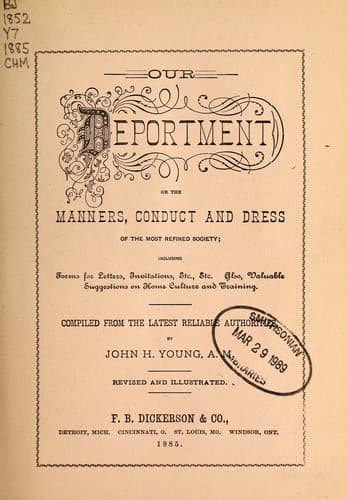
Our Deportment: Or the Manners, Conduct and Dress of the Most Refined SocietyYoung, John H.
General
Our Deportment: Or the Manners, Conduct and Dress of the Most Refined Society
Young, John H.
Etiquette
A gentleman should avoid talking about his business or profession,
unless such matters are drawn from him by the person with whom he is
conversing. It is in bad taste, particularly, to employ technical or
professional terms in general conversation.
Long arguments or heated discussions are apt to be tiresome to others,
and should be avoided.
It is considered extremely ill-bred for two persons to whisper in
society, or to converse in a language with which all persons are not
familiar.
Avoid talking too much, and do not inflict upon your hearers
interminably long stories, in which they can have but little interest.
[Illustration]
CHAPTER IX.
Dinner Giving and Dining Out.
Dining should be ranked among the fine arts. A knowledge of dinner-table
etiquette is all important in many respects; but chiefly in this: that
it is regarded as one of the strong tests of good breeding. Dinners are
generally looked upon as entertainments for married people and the
middle aged, but it is often desirable to have some young unmarried
persons among the guests.
WHOM TO INVITE.
Those invited should be of the same standing in society. They need not
necessarily be friends, nor even acquaintances, but, at dinner, as
people come into closer contact than at a dance, or any other kind of a
party, those only should be invited to meet one another who move in the
same class of circles. Care must, of course, be taken that those whom
you think agreeable to each other are placed side by side around the
festive board. Good talkers are invaluable at a dinner party--people who
have fresh ideas and plenty of warm words to clothe them in; but good
listeners are equally invaluable.
INVITATIONS.
Invitations to dinner parties are not usually sent by post, in cities,
and are only answered by post where the distance is such as to make it
inconvenient to send the note by hand. They are issued in the name of
the gentleman and lady of the house, from two to ten days in advance.
They should be answered as soon as received, without fail, as it is
necessary that the host and hostess should know who are to be their
guests. If the invitation is accepted, the engagement should, on no
account, be lightly broken. This rule is a binding one, as the
non-arrival of an expected guest produces disarrangement of plans.
Gentlemen cannot be invited without their wives, where other ladies than
those of the family are present; nor ladies without their husbands, when
other ladies are invited with their husbands. This rule has no
exceptions. No more than three out of a family should be invited, unless
the dinner party is a very large one.
MANNER OF WRITING INVITATIONS.
The invitations should be written on small note paper, which may have
the initial letter or monogram stamped upon it, but good taste forbids
anything more. The envelope should match the sheet of paper. The
invitation should be issued in the name of the host and hostess. The
form of invitations should be as follows:
Public-domain text, read in full here on John Shaqi.
Reviews
Reviews
No reviews yet
Be the first to share your thoughts on this work.
Elsewhere in the archive
Join the Discussion
Join the discussion
Sign in to leave a comment or review.
Sign InorCreate an account