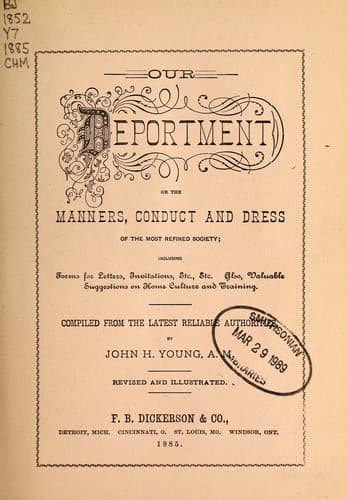
Our Deportment: Or the Manners, Conduct and Dress of the Most Refined SocietyYoung, John H.
General
Our Deportment: Or the Manners, Conduct and Dress of the Most Refined Society
Young, John H.
Etiquette
A snow-white cloth of the finest damask, beautiful china, glistening or
finely engraved glass, and polished plate are considered essential to a
grand dinner. Choice flowers, ferns and mosses tastefully arranged, add
much to the beauty of the table. A salt-cellar should be within the
reach of every guest. Napkins should be folded square and placed with a
roll of bread upon each plate. The dessert is placed on the table amidst
the flowers. An _epergne_, or a low dish of flowers, graces the centre;
stands of bon-bons and confectionery are ranged on both sides of the
table, which complete the decorations of the table. The name of each
guest, written upon a card and placed one on each plate, marks the seat
assigned.
ASSIGNING PARTNERS FOR DINNER.
The number at a dinner should not be less than six, nor more than twelve
or fourteen. Then the host will be able to designate to each gentleman
the lady whom he is to conduct to the table; but when the number exceeds
this limit it is a good plan to have the name of each couple written
upon a card and enclosed in an addressed envelope, ready to be handed to
the gentleman by the servant, before entering the drawing-room, or left
on a tray for the guests to select those which bear their names.
If a gentleman finds upon his card the name of a lady with whom he is
unacquainted, he requests the host to present him immediately after he
has spoken with the hostess, also to any members of the family with whom
he is not acquainted.
INTRODUCTIONS.
All the guests should secure introductions to the one for whom the
dinner is given. If two persons, unknown to each other, find themselves
placed side by side at a table, they may enter into conversation without
an introduction.
ARRANGEMENTS OF GUESTS AT THE TABLE.
When dinner is announced, the host offers his right arm to the lady he
is to escort to the table. The others follow, arm in arm, the hostess
being the last to leave the drawing-room. Age should take the precedence
in proceeding from the drawing-room to the dining-room, the younger
falling back until the elder have advanced. The host escorts the eldest
lady or the greatest stranger, or if there be a bride present,
precedence is given to her, unless the dinner is given for another
person, in which case he escorts the latter. The hostess is escorted
either by the greatest stranger, or some gentleman whom she wishes to
place in the seat of honor, which is at her right. The host places the
lady whom he escorts at his right. The seats of the host and hostess may
be in the middle and at opposite sides of the table, or at the opposite
ends. Husbands should not escort their wives, or brothers their sisters,
as this partakes of the nature of a family gathering.
DINNER A LA RUSSE.
Public-domain text, read in full here on John Shaqi.
Reviews
Reviews
No reviews yet
Be the first to share your thoughts on this work.
Elsewhere in the archive
Join the Discussion
Join the discussion
Sign in to leave a comment or review.
Sign InorCreate an account