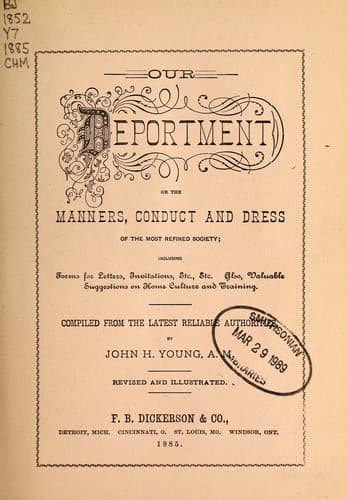
Our Deportment: Or the Manners, Conduct and Dress of the Most Refined SocietyYoung, John H.
General
Our Deportment: Or the Manners, Conduct and Dress of the Most Refined Society
Young, John H.
Etiquette
[Illustration:
Mr. and Mrs. Potter request the pleasure of Mr.
and Mrs. Barton's company at dinner on Thursday,
the 13th of October at 5 o'clock.]
An answer should be returned at once, so that if the invitation is
declined the hostess may modify her arrangements accordingly.
INVITATION ACCEPTED.
An acceptance may be given in the following form, and may be sent either
by post or messenger:
[Illustration:
Mr. and Mrs. Barton have much pleasure in
accepting Mr. and Mrs. Potter's invitation for
October 13th.]
INVITATION DECLINED.
The invitation is declined in the following manner:
[Illustration:
Mr. and Mrs. Barton regret that a previous
engagement (_or whatever the cause may be_)
prevents their having the pleasure of accepting
Mr. and Mrs. Potter's invitation at dinner for
October 13th.]
Or,
[Illustration:
Mr. and Mrs. Barton regret exceedingly that owing
to (_whatever the preventing cause may be_), they
cannot have the pleasure of dining with Mr. and
Mrs. Potter on Thursday, October 13th.]
Whatever the cause for declining may be, it should be stated briefly,
yet plainly, that there may be no occasion for misunderstanding or hard
feelings.
INVITATION TO TEA-PARTY.
The invitation to a tea-party may be less formal. It may take the form
of a friendly note, something in this manner:
[Illustration:
Dear Miss Summer:
We have some friends coming to drink tea with us
to-morrow: will you give us the pleasure of your
company also? We hope you will not disappoint us.]
FAILING TO FILL AN ENGAGEMENT.
When it becomes absolutely necessary to break an engagement once made
for dinner or tea, a note must be sent at once to the hostess and host,
with full explanation of the cause, so that your place may be supplied,
if possible.
PUNCTUALITY.
The hour generally selected in cities is after business hours, or from
five to eight o'clock. In the country or villages it may be an hour or
two earlier. To be punctual at the hour mentioned is obligatory. If you
are too early you are in the way; if too late you annoy the hostess,
cause impatience among the assembled guests, and perhaps spoil the
dinner. Fifteen minutes is the longest time required to wait for a tardy
guest.
THE SUCCESS OF A DINNER.
A host and hostess generally judge of the success of a dinner by the
manner in which conversation has been sustained. If it has flagged
often, it is considered proof that the guests have not been congenial;
but if a steady stream of talk has been kept up, it shows that they have
smoothly amalgamated, as a whole. No one should monopolize conversation,
unless he wishes to win for himself the appellation of a bore, and be
avoided as such.
THE TABLE APPOINTMENTS.
Public-domain text, read in full here on John Shaqi.
Reviews
Reviews
No reviews yet
Be the first to share your thoughts on this work.
Elsewhere in the archive
Join the Discussion
Join the discussion
Sign in to leave a comment or review.
Sign InorCreate an account