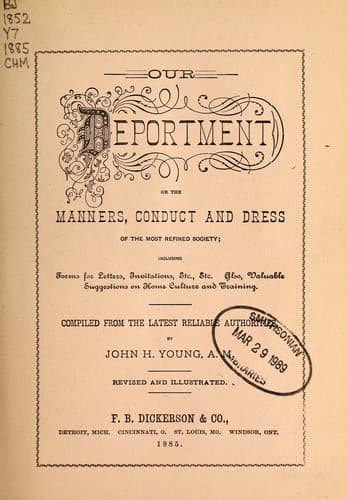
Our Deportment: Or the Manners, Conduct and Dress of the Most Refined SocietyYoung, John H.
General
Our Deportment: Or the Manners, Conduct and Dress of the Most Refined Society
Young, John H.
Etiquette
[Illustration]
CHAPTER XI.
Receptions, Parties and Balls.
Morning receptions, as they are called, but more correctly speaking,
afternoon parties, are generally held from four to seven o'clock in the
afternoon. Sometimes a sufficient number for a quadrille arrange to
remain after the assemblage has for the most part dispersed.
THE DRESS.
The dress for receptions is, for men, morning dress; for ladies,
demi-toilet, with or without bonnet. No low-necked dress nor short
sleeves should be seen at day receptions, nor white neck-ties and dress
coats.
The material of a lady's costume may be of velvet, silk, muslin, gauze
or grenadine, according to the season of the year, and taste of the
wearer, but her more elegant jewelry and laces should be reserved for
evening parties.
THE REFRESHMENTS.
The refreshments for "morning receptions" are generally light,
consisting of tea, coffee, frozen punch, claret punch, ices, fruit and
cakes. Often a cold collation is spread after the lighter refreshments
have been served, and sometimes the table is set with all the varieties,
and renewed from time to time.
INVITATIONS.
Invitations to a reception are simple, and are usually very informal.
Frequently the lady's card is sent with the simple inscription, "At Home
Thursday, from four to seven." No answers are expected to these
invitations, unless "R.S.V.P." is on one corner. One visiting card is
left by each person who is present, to serve for the after call. No
calls are expected from those who attend. Those who are not able to be
present, call soon after.
MUSICAL MATINEES.
A _matinee musicale_ partakes of the nature of a reception, and is one
of the most difficult entertainments attempted. For this it is necessary
to secure those persons possessing sufficient vocal and instrumental
talent to insure the success of the entertainment, and to arrange with
them a programme, assigning to each, in order, his or her part. It is
customary to commence with a piece of instrumental music, followed by
solos, duets, quartettes, etc., with instrumental music interspersed, in
not too great proportions. Some competent person is needed as
accompanist. It is the duty of the hostess to maintain silence among her
guests during the performance of instrumental as well as vocal music. If
any are unaware of the breach of good manners they commit in talking or
whispering at such times, she should by a gesture endeavor to acquaint
them of the fact. It is the duty of the hostess to see that the ladies
are accompanied to the piano; that the leaves of the music are turned
for them, and that they are conducted to their seats again. When not
intimately acquainted with them, the hostess should join in expressing
gratification.
The dress at a musical matinee is the same as at a reception, only
bonnets are more generally dispensed with. Those who have taken part,
often remain for a hot supper.
PARTIES IN THE COUNTRY.
Public-domain text, read in full here on John Shaqi.
Reviews
Reviews
No reviews yet
Be the first to share your thoughts on this work.
Elsewhere in the archive
Join the Discussion
Join the discussion
Sign in to leave a comment or review.
Sign InorCreate an account