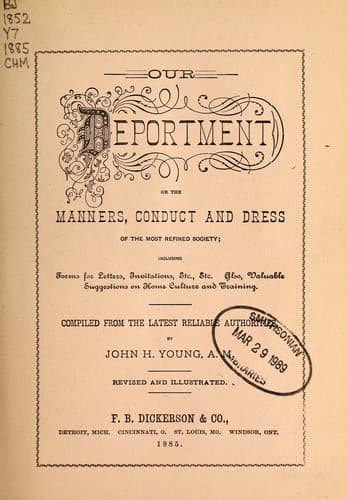
Our Deportment: Or the Manners, Conduct and Dress of the Most Refined SocietyYoung, John H.
General
Our Deportment: Or the Manners, Conduct and Dress of the Most Refined Society
Young, John H.
Etiquette
Though not customary for a married couple to dance together in society,
those men who wish to show their wives the compliment of such unusual
attention, if they possess any independence, will not be deterred from
doing so by their fear of any comments from Mrs. Grundy.
The sooner that we recover from the effects of the Puritanical idea that
clergymen should never be seen at balls, the better for all who attend
them. Where it is wrong for a clergyman to go, it is wrong for any
member of his church to be seen.
In leaving a ball room before the music has ceased, if no members of the
family are in sight, it is not necessary to find them before taking your
departure. If, however, the invitation is a first one, endeavor not to
make your exit until you have thanked your hostess for the
entertainment. You can speak of the pleasure it has afforded you, but it
is not necessary that you should say "it has been a grand success."
Young ladies must be careful how they refuse to dance, for unless a good
reason is given, a gentleman is apt to take it as evidence of personal
dislike. After a lady refuses, the gentleman should not urge her to
dance, nor should the lady accept another invitation for the same dance.
The members of the household should see that those guests who wish to
dance are provided with partners.
Ladies leaving a ball or party should not allow gentlemen to see them to
their carriages, unless overcoats and hats are on for departure.
When balls are given, if the weather is bad, an awning should be
provided for the protection of those passing from their carriages to the
house. In all cases, a broad piece of carpet should be spread from the
door to the carriage steps.
Gentlemen should engage their partners for the approaching dance, before
the music strikes up.
In a private dance, a lady cannot well refuse to dance with any
gentleman who invites her, unless she has a previous engagement. If she
declines from weariness, the gentleman will show her a compliment by
abstaining from dancing himself, and remaining with her while the dance
progresses.
[Illustration]
CHAPTER XII.
Etiquette of the Street.
The manners of a person are clearly shown by his treatment of the people
he meets in the public streets of a city or village, in public
conveyances and in traveling generally. The true gentleman, at all
times, in all places, and under all circumstances, is kind and courteous
to all he meets, regards not only the rights, but the wishes and
feelings of others, is deferential to women and to elderly men, and is
ever ready to extend his aid to those who need it.
THE STREET MANNERS OF A LADY.
The true lady walks the street, wrapped in a mantle of proper reserve,
so impenetrable that insult and coarse familiarity shrink from her,
while she, at the same time, carries with her a congenial atmosphere
which attracts all, and puts all at their ease.
Public-domain text, read in full here on John Shaqi.
Reviews
Reviews
No reviews yet
Be the first to share your thoughts on this work.
Elsewhere in the archive
Join the Discussion
Join the discussion
Sign in to leave a comment or review.
Sign InorCreate an account