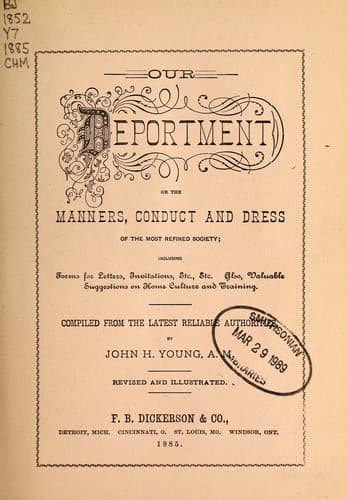
Our Deportment: Or the Manners, Conduct and Dress of the Most Refined SocietyYoung, John H.
General
Our Deportment: Or the Manners, Conduct and Dress of the Most Refined Society
Young, John H.
Etiquette
Rules in regard to proposals of marriage cannot be laid down, for they
are and should be as different as people. The best way is to apply to
the lady in person, and receive the answer from her own lips. If courage
should fail a man in this, he can resort to writing, by which he can
clearly and boldly express his feelings. A spoken declaration should be
bold, manly and earnest, and so plain in its meaning that there can be
no misunderstanding. As to the exact words to be used, there can be no
set formula; each proposer must be governed by his own ideas and sense
of propriety in the matter.
DO NOT PRESS AN UNWELCOME SUIT.
A gentleman should evince a sincere and unselfish affection for his
beloved, and he will show as well as feel that her happiness must be
considered before his own. Consequently he should not press an unwelcome
suit upon a young lady. If she has no affection for him, and does not
conceive it possible even to entertain any, it is cruel to urge her to
give her person without her love. The eager lover may believe, for the
time being, that such possession would satisfy him, but the day will
surely come when he will reproach his wife that she had no love for him,
and he will possibly make that an excuse for all manner of unkindness.
A LADY'S FIRST REFUSAL.
It is not always necessary to take a lady's first refusal as absolute.
Diffidence or uncertainty as to her own feelings may sometimes influence
a lady to reply in the negative, and after-consideration cause her to
regret that reply.
Though a gentleman may repeat his suit with propriety after having been
once repulsed, still it should not be repeated too often nor too long,
lest it should degenerate into importuning.
No lady worthy any gentleman's regard will say "no" twice to a suit
which she intends ultimately to receive with favor. A lady should be
allowed all the time she requires before making up her mind; and if the
gentleman grows impatient at the delay, he is always at liberty to
insist on an immediate answer and abide by the consequences of his
impatience.
A LADY'S POSITIVE REFUSAL.
A lady who really means "no" should be able to so say it as to make her
meaning unmistakable. For her own sake and that of her suitor, if she
really desires the suit ended her denial should be positive, yet kind
and dignified, and of a character to let no doubt remain of its being
final.
TRIFLING WITH A LADY.
A man should never make a declaration in a jesting manner. It is most
unfair to a lady. He has no right to trifle with her feelings for mere
sport, nor has he a right to hide his own meaning under the guise of a
jest.
A DOUBTFUL ANSWER.
Nothing can be more unfair or more unjustifiable than a doubtful answer
given under the plea of sparing the suitor's feelings. It raises false
hopes. It renders a man restless and unsettled. It may cause him to
express himself or to shape his conduct in such a manner as he would not
dream of doing were his suit utterly hopeless.
Public-domain text, read in full here on John Shaqi.
Reviews
Reviews
No reviews yet
Be the first to share your thoughts on this work.
Elsewhere in the archive
Join the Discussion
Join the discussion
Sign in to leave a comment or review.
Sign InorCreate an account