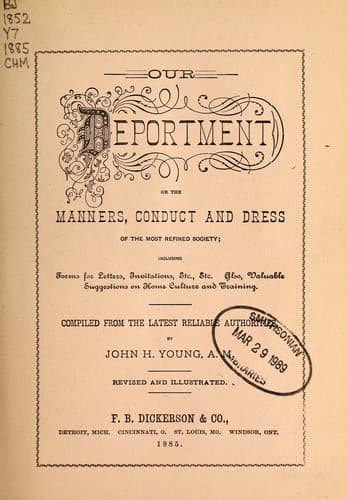
Our Deportment: Or the Manners, Conduct and Dress of the Most Refined SocietyYoung, John H.
General
Our Deportment: Or the Manners, Conduct and Dress of the Most Refined Society
Young, John H.
Etiquette
No young man who would shrink from being guilty of a great impropriety,
should ever prolong his visits beyond ten o'clock, unless it be the
common custom of the family to remain up and to entertain visitors to a
later hour, and the visit paid is a family one and not a _tete-a-tete_.
Two hours is quite long enough for a call; and the young man will give
evidence of his affection no less than his consideration, by making his
visits short, and, if need be, making them often, rather than by
prolonging to unreasonable hours.
LOVERS' DISPUTES.
Neither party should try to make the other jealous for the purpose of
testing his or her affection. Such a course is contemptible; and if the
affections of the other are permanently lost by it, the offending party
is only gaining his or her just deserts. Neither should there be
provocation to little quarrels for the foolish delight of
reconciliation. No lover will assume a domineering attitude over his
future wife. If he does so, she will do well to escape from his thrall
before she becomes his wife in reality. A domineering lover will be
certain to be more domineering as a husband.
BREAKING AN ENGAGEMENT.
Sometimes it is necessary to break off an engagement. Many circumstances
will justify this. Indeed anything which may occur or be discovered
which shall promise to render the marriage an unsuitable or unhappy one
is, and should be accepted as, justification for such rupture. Still,
breaking an engagement is always a serious and distressing thing, and
ought not to be contemplated without absolute and just reasons. It is
generally best to break an engagement by letter. By this means one can
express himself or herself more clearly, and give the true reason for
his or her course much better than in a personal interview. The letter
breaking the engagement should be accompanied by everything, in the way
of portraits, letters or gifts, that has been received during the
engagement. Such letters should be acknowledged in a dignified manner,
and no efforts should be made or measures be taken to change the
decision of the writer, unless it is manifest that he or she is greatly
mistaken in his or her premises. A similar return of letters, portraits
and gifts should be made.
Many men, in taking retrospective glances, remember how they were
devoted to women, the memory of whom calls up only a vague sort of
wonder how they ever could have fallen into the state of infatuation in
which they once were. The same may be said of many women. Heart-breaking
separations have taken place between young men and young women who have
learned that the sting of parting does not last forever. The heart,
lacerated by a hopeless or misplaced attachment, when severed from the
cause of its woe, gradually heals and prepares itself to receive fresh
wounds, for affection requires either a constant contemplation of, or
intercourse, with its object, to keep it alive.
[Illustration]
CHAPTER XVII.
Etiquette of Weddings.
Public-domain text, read in full here on John Shaqi.
Reviews
Reviews
No reviews yet
Be the first to share your thoughts on this work.
Elsewhere in the archive
Join the Discussion
Join the discussion
Sign in to leave a comment or review.
Sign InorCreate an account