"If you really mean that, I am very grateful. I wanted to tell you
everything, and talk it over, and see what you thought best to be done.
But of course I shouldn't dream of forcing my confidence upon you. It's
a delicate matter and only because we were such intimate friends."--
"If you will have done with all this preamble," Constance interrupted,
with forced calm, "and tell me what there is to be told, I am quite
willing to listen."
"Well, I will do so. It's this. I am in love with May Tomalin, and I
want to marry her."
Their eyes met, Dyce was smiling, an uneasy, abashed smile. Constance
wore an expression of cold curiosity, and spoke in a corresponding
voice.
"Have you asked her to do so?"
"Not yet," Lashmar replied.
For a moment, Constance gazed at him; then she said, quietly:
"I don't believe you."
"That's rather emphatic," cried Dyce, affecting a laugh. "It conveys my
meaning. I don't believe you, for several reasons. One of them is--"
She broke off, and rose from her chair. "Please wait; I will be back in
a moment."
Lashmar sat looking about the room. He began to be aware that he had
not breakfasted,--a physical uneasiness added to the various forms of
disquiet from which his mind was suffering. When Constance re-entered,
he saw she had a book in her hand, a book which by its outward
appearance he at once recognised.
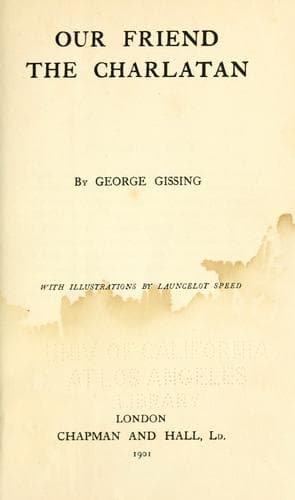
"Do you know this?" she asked, holding the volume to him. "I received
it yesterday, and have already gone through most of it. I find it very
interesting."
"Ah, I know it quite well," Dyce answered, fingering the pages. "A most
suggestive book. But--what has it to do with our present conversation?"
Constance viewed him wonderingly. If he felt at all disconcerted,
nothing of the kind appeared in his face, which wore, indeed, a look of
genuine puzzlement.
"Have you so poor an opinion of my intelligence?" she asked, with
subdued anger. "Do you suppose me incapable of perceiving that all the
political and social views you have been living upon were taken
directly from this book? I admire your audacity. Few educated men,
nowadays, would have ventured on so bold a--we call it plagiarism."
Dyce stared at her.
"You are very severe," he exclaimed, on the note of deprecation. "Views
I have been 'living upon?' It's quite possible that now and then
something I had read there chanced to come into my talk; but who gives
chapter and verse for every conversational allusion? You astound me. I
see that, so far from wishing me well, you have somehow come to regard
me with positive ill-feeling. How has it come about, Constance?"
Public-domain text, read in full here on John Shaqi.
Reviews
Reviews
No reviews yet
Be the first to share your thoughts on this work.
Elsewhere in the archive
Join the Discussion
Join the discussion
Sign in to leave a comment or review.
Sign InorCreate an account