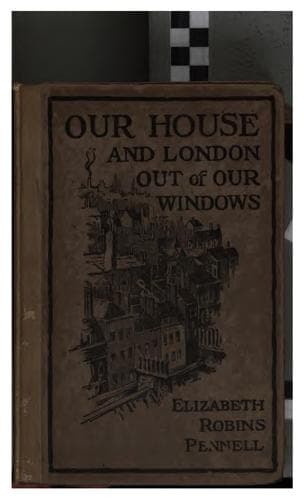
Our House and London out of Our WindowsPennell, Elizabeth Robins
General
Our House and London out of Our Windows
Pennell, Elizabeth Robins
London (England) -- Description and travel; Pennell, Elizabeth Robins, 1855-1936 -- Homes and haunts -- England -- London
Ours are not the Beggars of whose decay Elia complained; though he could
not have believed that the art of begging was in any more danger of
being lost than the art of lying. His sort have still their place at the
crowded crossing, at the corners of streets and turnings of alleys--they
are always with us. I rarely go out that I do not meet the cripple who
swings himself along on his crutches through the throngs at Charing
Cross, or the blind man who taps his way down the Strand, or the
paralytic in her little cart close to St. Martin's, and I too should
complain were they to disappear. These are Beggars I do not mind. They
have their picturesque uses. They carry on an old tradition. They are
licensed to molest me, and their demands, with their thanks when I give
and their curses when I do not, are the methods of a venerable and
honoured calling. Besides, I can escape them if I choose. I can cross
the street at the approach of the cripple, I can dodge the blind man, I
can look away as I pass the paralytic, and so avoid the irritation of
giving when I do not want to or the discomfort of hearing their opinion
of me when I refuse. But to our Beggars I do object, and from them there
is no escape. They belong to a new species, and have abandoned the
earlier methods as crude and primitive. They make a profession neither
of disease nor of deformity, but of having come down in the world. They
scorn to stoop to "rags and the wallet," which they have exchanged for a
top hat and frock coat. They take out no license, for they never beg in
the streets; instead, they assault us at our door, where they do not ask
for alms but claim the gift, they call a loan, as their right. They are
bullies, brigands, who would thrust the virtue of charity upon us, and
if, as the philosopher thinks, it is a test of manners to receive, they
come out of it with dignity, for their fiction of a loan saves them, and
us, from the professional profuseness of the Beggar's thanks.
It was only when I moved into chambers in the Quarter that they began to
come to see me. Hitherto, my life in London had been spent in lodgings,
where, if I was never free from Beggars in the form of those intimate
friends who are always short of ten pounds to pay their rent or ten
shillings to buy a hat, it was the landlady's affair when the Beggars
who were strangers called.
Chambers, however, gave me a front door at which they could ring and an
address in the Directory in which they could find out where the door
was; and had my object been to make a study of them and their manners, I
could not have hit upon a better place to collect my material.
Public-domain text, read in full here on John Shaqi.
Reviews
Reviews
No reviews yet
Be the first to share your thoughts on this work.
Elsewhere in the archive
Join the Discussion
Join the discussion
Sign in to leave a comment or review.
Sign InorCreate an account