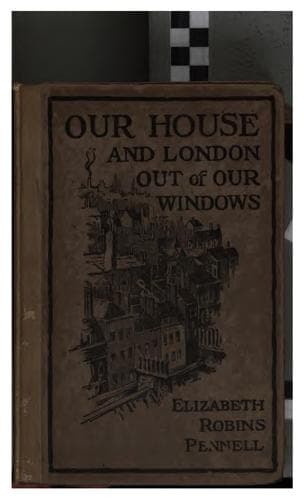
Our House and London out of Our WindowsPennell, Elizabeth Robins
General
Our House and London out of Our Windows
Pennell, Elizabeth Robins
London (England) -- Description and travel; Pennell, Elizabeth Robins, 1855-1936 -- Homes and haunts -- England -- London
The Quarter has also its own population, so distinct from other
Londoners that I am struck by the difference no further away than the
other side of the Strand. Our housekeepers are a species apart, so are
our milkmen behind their little carts. Our types are a local growth.
Nowhere else in London could I meet anybody in the slightest like the
pink-eyed, white-haired, dried-up little old man, with a jug in his
hand, whom I see daily on his way to or from our public-house; or like
the middle-aged dandy who stares me out of countenance as he saunters
homeward in the afternoon, a lily or chrysanthemum, according to the
season, in one hand and a brown paper bag of buns in the other; or like
the splendid old man of military bearing, with well-waxed moustache and
well-pointed beard, whose Panama hat in summer and fur-lined cloak in
winter have become as much fixtures in the Quarter as our Adam houses or
our view of the river, and who spends his days patrolling the Terrace in
front of our frivolous club or going into it with members he happens to
overtake at the front door,--where his nights are spent no native of the
Quarter can say. Nor is any other crowd like our crowd that collects
every Sunday evening as St. Martin's bells begin to ring for evening
service, that grows larger and larger until streets usually empty are
packed solid, and that melts away again before ten. It is made up mostly
of youths to whom the cap is as indispensable a symbol of class as the
silk hat further west, and young girls who run to elaborate hair and
feathers. They have their conventions, which are strictly observed. One
is to walk with arms linked; a second, to fill the roadway as well as
the pavement, to the despair of taxicabs and cycles endeavouring to
toot and ring a passage through; a third, to follow the streets that
bound the Quarter on three sides and never to trespass into others. How
the custom originated, I leave it to the historian to decide. It may go
back to the Britons who painted themselves blue, it may be no older than
the Romans. All I know with certainty is that the Sunday evening walk is
a ceremony of no less obligation for the Quarter than the Sunday morning
parade in the Row is for Mayfair.
Public-domain text, read in full here on John Shaqi.
Reviews
Reviews
No reviews yet
Be the first to share your thoughts on this work.
Elsewhere in the archive
Join the Discussion
Join the discussion
Sign in to leave a comment or review.
Sign InorCreate an account