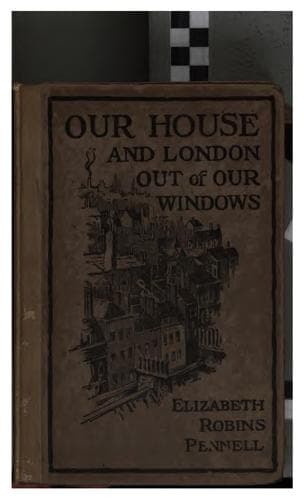
Our House and London out of Our WindowsPennell, Elizabeth Robins
General
Our House and London out of Our Windows
Pennell, Elizabeth Robins
London (England) -- Description and travel; Pennell, Elizabeth Robins, 1855-1936 -- Homes and haunts -- England -- London
she retained her beautiful placidity, though I, when I realized the full
weight of the burden she had to bear, began to wonder less how, than
why, the poor live.
Mrs. Maxfielde came in the early spring. By the time winter, with its
fogs, set in, age had so far overtaken her that she could not manage to
attend to her husband and his wants and then drag her old body to our
chambers by seven o'clock in the morning. It was she who gave notice; I
never should have had the courage. We parted friends, and she was so
amiable as not to deprive me of her problems with her services. When she
could not work for me, she visited me, making it her rule to call on
Monday afternoon; a rule she observed with such regularity that I
fancied Monday must be her day for collecting the husband's income from
the parish and her own from private sources. She rarely allowed a week
to pass without presenting herself, always appearing in the same
Victorian costume and carrying off the interview with the same Victorian
manner. She never stooped to beg, but her hand was ready for the coin
which I slipped into it with the embarrassment of the giver, but which
she received with enviable calmness and a little curtsy. The hour of her
visit was so timed that, when her talk with me was over, she could
adjourn to the kitchen for dinner and, under Augustine's rule, a glass
of wine, which, though beer would have been more to her taste, she drank
as a concession to the poor foreigner who did not know any better.
Before a second winter had passed, Mrs. Maxfielde was forced to admit
that she was too old for anybody to want her, or to accept a post if
anybody did. But, all the same, the paralytic clung to his shadow of
life with the obstinate tenacity of the human derelict, and she clung to
her idea of home, and they starved on in the room the parish paid for
until it was a positive relief to me when, after more years of
starvation than I cared to count, she came to announce his death. It was
no relief to her. She was full of grief, and permitted nothing to
distract her from the luxury she made of it. The coin which passed from
my hand to hers on the occasion of this visit, doubled in token of
condolence, was invested in an elaborate crape bonnet, and she left it
to me to worry about her future. I might have afforded to accept her
trust with a greater show of enthusiasm, for, at once and with
unlooked-for intelligence, the parish decided to allow her the same
weekly sum her husband had received, and Mrs. Maxfielde, endowed with
this large and princely income, became a parent so worthy of filial
devotion that a daughter I had never heard of materialized, and
expressed a desire to share her home with her mother.
Public-domain text, read in full here on John Shaqi.
Reviews
Reviews
No reviews yet
Be the first to share your thoughts on this work.
Elsewhere in the archive
Join the Discussion
Join the discussion
Sign in to leave a comment or review.
Sign InorCreate an account