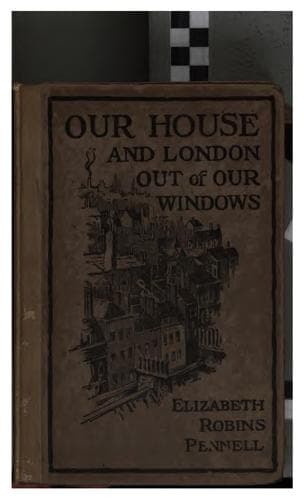
Our House and London out of Our WindowsPennell, Elizabeth Robins
General
Our House and London out of Our Windows
Pennell, Elizabeth Robins
London (England) -- Description and travel; Pennell, Elizabeth Robins, 1855-1936 -- Homes and haunts -- England -- London
The daughter was married, her husband was an unskilled labourer, and
they had a large and increasing family. It is likely that Mrs. Maxfielde
paid in more than money for the shelter, and that her own
flesh-and-blood was less chary than strangers would have been in
employing her services, and less mindful of the now more than seventy
years she had toiled to live. Perhaps her visits at this period were a
little more frequent, perhaps her dinners were eaten and her wine drunk
with a little more eagerness. But she refrained from any pose, she
indulged in no heroics, she entertained me with no whinings, no railings
against the ingratitude sharper than a serpent's tooth. However she got
her ease, it was not in weeping, and what she had to bear from her
daughter she bore in silence. Her Victorian sense of propriety would
have been offended by a display of feeling. She became so pitiful a
figure that I shrank from her visits. But she was content, she found no
fault with life, and wealth being a matter of comparison, I am sure she
was, in her turn, moved to pity for the more unfortunate who had not
kept themselves out of the workhouse. Had she had her way, she would
have been willing to slave indefinitely for her daughter and her
daughter's children. But Death was wiser and brought her the rest she
deserved so well and so little craved.
A couple of years or so after the loss of her husband, and after she had
failed to appear, much to my surprise, on three or four Mondays in
succession, a letter came from her daughter to tell me that never again
would Monday bring Mrs. Maxfielde to my chambers. There had been no
special illness. She had just worn out, that was all. Her time had come
after long and cruel days of toil and her passing was unnoted, for hers
was a place easily filled,--that was the grisly thing about it. J. and I
sent a wreath of flowers for the funeral, knowing that she would have
welcomed it as propriety's crown of propriety, and it was my last
communication with the Maxfielde family. I had never met the daughter,
and I was the more reluctant to go abroad in search of objects of
charity because they had such an inconsiderate way of seeking me out in
my own kitchen. I was already "suited" with another old woman in Mrs.
Maxfielde's place. I was already visited by one or two others. In fact,
I was so surrounded by old women that Augustine, when she first came to
the rescue, used to laugh with the insolence of youth at _les vieilles
femmes de Madame_.
Public-domain text, read in full here on John Shaqi.
Reviews
Reviews
No reviews yet
Be the first to share your thoughts on this work.
Elsewhere in the archive
Join the Discussion
Join the discussion
Sign in to leave a comment or review.
Sign InorCreate an account