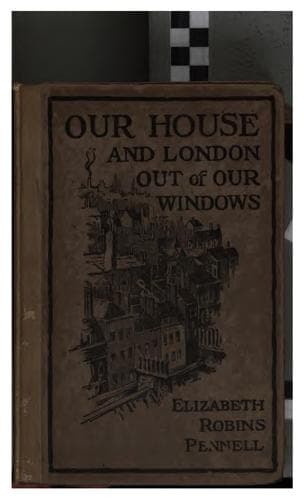
Our House and London out of Our WindowsPennell, Elizabeth Robins
General
Our House and London out of Our Windows
Pennell, Elizabeth Robins
London (England) -- Description and travel; Pennell, Elizabeth Robins, 1855-1936 -- Homes and haunts -- England -- London
If I could discover any weak spot by which I could reach her, I used to
think something might be gained, and I lost much time in studying how to
work upon her emotions. But her emotions were as far to seek as her
morals. Even family ties, usually so strong in France, had no hold upon
her. If she adored her little Ernest, it was because he brought her in
three shillings and sixpence a week. There was no adoration for her
little girl who occasionally wrote from the Pas-de-Calais and asked her
for money. I saw one of the child's letters in which she implored
Clementine to pay for a white veil and white shoes; she was going to
make her first communion, and the good adopted mother could pay for no
more than the gown. The First Communion is the greatest event in the
French child's life; there could be no deeper disgrace than not to be
dressed for it, and the appeal must have moved every mother who read it,
except Clementine. To her it was comic, and she disposed of it with
giggles: "_C'est drole quand meme, d'avoir une fille de cet age_," and
funnier that she could be expected to pay for anything for anybody.
But if her family awoke in her no sentiment, her "home" did, though it
was of the kind that Lamb would have classed with the "no homes." The
tenacity with which she clung to it was her nearest approach to strong
feeling. I suppose it was because she had so long climbed the stairs of
others that she took such complete satisfaction in the two shabby little
rooms to which she gave the name. I had a glimpse of them, never to be
forgotten, once when she failed to come for two days, and I went to look
her up. The street reeked with the smell of fried fish and onions; it
was filled with barrows of kippers and haddocks and whelks; it was lined
with old-clothes shops; it was crowded with frowzy women and horribly
dirty children. And the halls and stairs of the tenement where she lived
were black with London smoke and greasy with London dirt. I did not feel
clean afterwards until I had had a bath, and it was never again as easy
to reconcile myself to Clementine's daily reappearance in our midst. But
to her the rooms were home, and for that reason she would have stayed on
in a grimier and more malodorous neighbourhood, if such a thing could
be, in preference to living in the cleanest and freshest London
workhouse at the rate-payers' expense. Her objection to going into
service except as a charwoman was that she would have to stay the night.
"_Je ne serais pas chez moi_"; and much as she prized her comfort, it
was not worth the sacrifice. On the contrary, she was prepared to
sacrifice her comfort, dear as it was to her, that she might retain her
home. She actually went to the length of taking in as companion an
Italian workman she met by accident, not because he offered to marry
her, which he did not, but because, according to his representations, he
was making twenty-five shillings a week and would help to pay the rent.
Public-domain text, read in full here on John Shaqi.
Reviews
Reviews
No reviews yet
Be the first to share your thoughts on this work.
Elsewhere in the archive
Join the Discussion
Join the discussion
Sign in to leave a comment or review.
Sign InorCreate an account