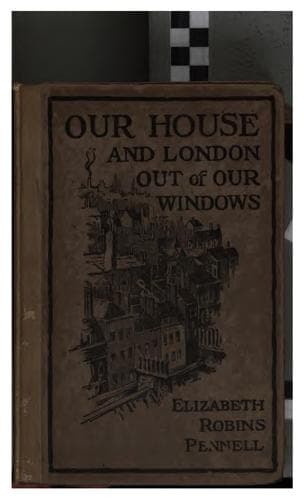
Our House and London out of Our WindowsPennell, Elizabeth Robins
General
Our House and London out of Our Windows
Pennell, Elizabeth Robins
London (England) -- Description and travel; Pennell, Elizabeth Robins, 1855-1936 -- Homes and haunts -- England -- London
Until then I believed that, whatever crimes and vices might be laid at
her door, dishonesty was not to be counted among them. I even boasted of
her honesty as an excuse for my keeping her, nuisance as she was. I
think I should have doubted her guilt if the report of it only had
reached me. But I could not doubt the testimony of my own eyes when
there was discovered, carefully packed in the capacious bag she always
carried, one of my best napkins, a brand-new tea-cloth, and a few
kitchen knives and forks that could not have strayed there of
themselves. I could see in the articles selected her tender concern for
the comfort of her _petit Anglais_ and her practical wish to prepare her
establishment for his coming, and probably it showed her consideration
for me that she had been content with such simple preparations. But the
value of the things themselves and her object in appropriating them had
nothing to do with the main fact that, after all we had done and
endured, she was stealing from us. "We should wipe two words from our
vocabulary: gratitude and charity," Stevenson once wrote. Clementine
wiped out the one so successfully that she left me with no use for the
other. I told her she must go, and this time I was in good earnest.
To Clementine, however, nothing could have seemed less possible. She
could not understand that a petty theft would make her less
indispensable, or that I would strain at a gnat after swallowing so many
camels. Within a week she was knocking at our door and expressing her
willingness to resume her place in our chambers. She was not discouraged
by the refusal to admit her, but a few days later, this time by letter,
she again assured me that she waited to be recalled, and she referred to
the desire of her _petit Anglais_ in the matter. She affected penitence,
admitting that she had committed _une "Betisse"_--the spelling is
hers--and adding: "_avoir agit ainsi avec des maitres aussi bons, ce
n'est pas pardonable. Je vous assure que si un jour je devien riche, ou
peut etre plus pauvre, que dans ma richesse, comme dans ma plus grande
misere, je ne pourrais jamais oublier les bons maitres Monsieur et
Madame, car jamais dans ma vie d'orpheline, je n'aie jamais rencontre
d'aussi bons maitres._" She also reminded me that she lived in the hope
that _Madame_ would not forget the promised present of linen and a hat.
I made no answer. Another letter followed, penitence now exchanged for
reproaches. She expostulated with me for taking the bread out of the
mouth of her _petit innocent_--Ernest--the little innocent whom the
slums had nothing more to teach. This second letter met the same fate
as the first, but her resources were not exhausted. In a third she tried
the dignity of sorrow: "_Ma faute m'a rendu l'ame si triste_" and, as
this had no effect, she used in a fourth the one genuine argument of
them all, her hunger: "_Enfin il faut que je tache d'oublier, mais en
Public-domain text, read in full here on John Shaqi.
Reviews
Reviews
No reviews yet
Be the first to share your thoughts on this work.
Elsewhere in the archive
Join the Discussion
Join the discussion
Sign in to leave a comment or review.
Sign InorCreate an account