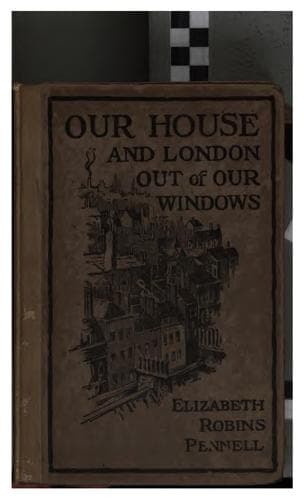
Our House and London out of Our WindowsPennell, Elizabeth Robins
General
Our House and London out of Our Windows
Pennell, Elizabeth Robins
London (England) -- Description and travel; Pennell, Elizabeth Robins, 1855-1936 -- Homes and haunts -- England -- London
Coal was as yet so remote that we would have agreed to anything in our
impatience to look out of the windows, and, reassured by us, she became
the obsequious housekeeper again, getting the keys, toiling with us up
the three flights of stairs, unlocking the double door,--for, as I have
said, there is an "oak" to "sport,"--ushering us into the chambers with
the Adam mantelpieces and decorations and the windows that brought us
there, dropping the correct "Sir" and "Madam" into her talk, accepting
without a tremor the shilling we were ashamed to offer, and realizing so
entirely our idea of what a housekeeper in London chambers ought to be,
that her outbreak over the coal we had not ordered, and might never
order, was the more perplexing.
I understood it before we were settled in our chambers, for they were
not really ours until after a long delay over the legal formalities with
which the English love to entangle their simplest transactions at
somebody else's expense, and a longer one in proving our personal and
financial qualifications, the landlord being disturbed by a suspicion
that, like the Housekeeper's daughter, we were in _the_ profession and
spent most of our time "resting," a suspicion confirmed by the escape of
the last tenant, also in _the_ profession, with a year's rent still to
pay. And then came much the longest delay of all over the British
Workman, who, once he got in, threatened never to get out. In the mean
while we saw the Housekeeper almost every day.
We did not have to see her often to discover that she was born a
housekeeper, that she had but one thought in life, and that this was the
house under her charge. I am sure she believed that she came into the
world to take care of it, unless indeed it was built to be taken care of
by her. She belonged to a generation in England who had not yet been
taught the folly of interest in their work, and she was old-fashioned
enough to feel the importance of the post she filled. She would have
lost her self-respect had she failed in the slightest detail of her duty
to the house. From the first, the spotless marvel she made of it divided
our admiration with our windows. The hall and front steps were
immaculate, the white stone stairs shone, there was not a speck of dust
anywhere, and I appreciated the work this meant in an old London
building, where the dirt not only filters through doors and windows, but
oozes out of the walls and comes up through the floors. She did not
pretend to hide her despair when our painters and paperers tramped and
blundered in and out; she fretted herself ill when our furniture was
brought up the three flights of her shining stairs. Painters and
paperers and the bringing up of furniture were rare incidents in the
life of a tenant and had to be endured. But coal, with its trail of
dust, was an endless necessity, and at least could be regulated. This
was why, after her daily cleaning was done, she refused to let it pass.
Public-domain text, read in full here on John Shaqi.
Reviews
Reviews
No reviews yet
Be the first to share your thoughts on this work.
Elsewhere in the archive
Join the Discussion
Join the discussion
Sign in to leave a comment or review.
Sign InorCreate an account