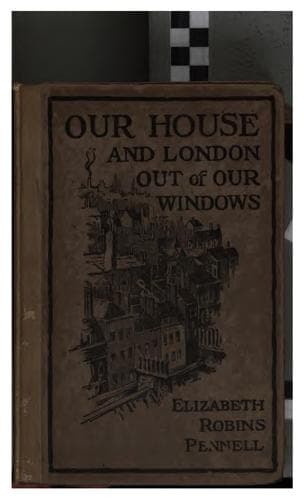
Our House and London out of Our WindowsPennell, Elizabeth Robins
General
Our House and London out of Our Windows
Pennell, Elizabeth Robins
London (England) -- Description and travel; Pennell, Elizabeth Robins, 1855-1936 -- Homes and haunts -- England -- London
Hitherto everybody had been patient with Mrs. Haines, for the London
housekeeper, though she has not got the tenants as completely in her
power as the Paris _concierge_, can, if she wants, make things very
disagreeable for them. Now that she was alone in the world, everybody
was kind to her. The landlord overlooked his announced decision "to
sack the pair," and retained her as housekeeper, though in losing her
husband she had lost her principal recommendation. The tenants raised a
fund to enable her to buy the mourning which is often a consolation in
widowhood. Work was offered to her in chambers which she had never
entered before, and I added to the tasks in ours. The housekeepers in
the street with families to support must have envied her. She had her
rooms rent free, wages from the landlord, plenty of extra work, and
though this might not seem affluence to people who do not measure their
income by pence or scramble for the odd shilling, it was wealth in
housekeeping circles.
Mrs. Haines, however, did not see her position in that light. She had
complained when work was not offered to her, she complained more
bitterly when it was. Perhaps her husband had had some restraining
influence upon her. I cannot say; but certainly once he was gone, she
gave up all pretence of controlling her temper. She would sweep like a
hurricane through the house, raging and raving, on the slightest
provocation. She led us a worse life than ever over the drain-pipe. She
left the house more and more to take care of itself, dust lying thick
wherever dust could lie, the stairs turned to a dingy grey, the walls
blackened with London smoke and grime. Once in a while she hired a
forlorn, ragged old woman to wash the stairs and brush the front-door
mat, for in London, more than anywhere else, "poverty is a comparative
thing," and every degree has one below to "soothe" it. No matter how
hard up Mrs. Haines was, she managed to scrape together a few pennies to
pay to have the work done for her rather than do it herself. The greater
part of her leisure she spent out of the house, and when I passed her
door I would see pinned up on it a bit of paper stating in neat, even
elegant, writing, "Apply on the First Floor for the Housekeeper," or
"Gone out. Back in ten minutes"; and hours, sometimes days, later the
same notice would still be there. She became as neglectful of herself as
of the house: her one dress grew shabbier and shabbier, her apron was
discarded, no detail of her toilet was attended to except the frizzing
of her coarse black hair. All this came about not at once, but step by
step, and things were very bad before J. and I admitted, even to each
other, that she was a disgrace to the house. We would admit it to nobody
else, and to my surprise the other tenants were as forbearing. I suppose
it was because they understood, as well as we did, that at a word to the
landlord she would be adrift in London, where for one vacant post of
Public-domain text, read in full here on John Shaqi.
Reviews
Reviews
No reviews yet
Be the first to share your thoughts on this work.
Elsewhere in the archive
Join the Discussion
Join the discussion
Sign in to leave a comment or review.
Sign InorCreate an account